

Description
Rubellite – a mosaic that changes the mood of the wall
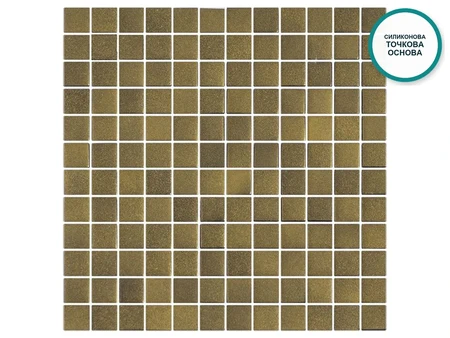
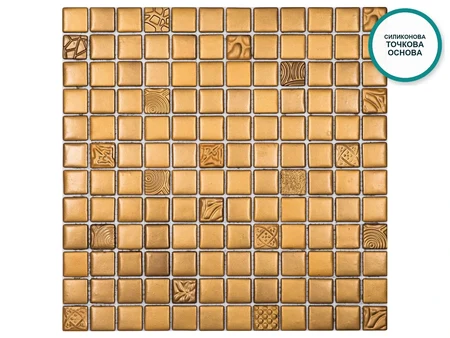
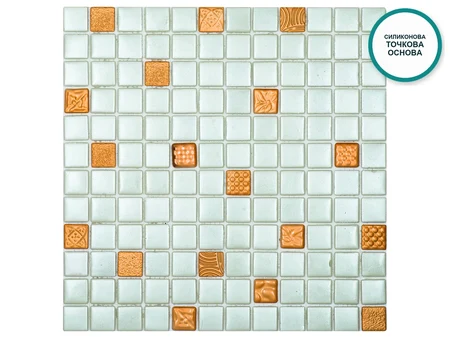
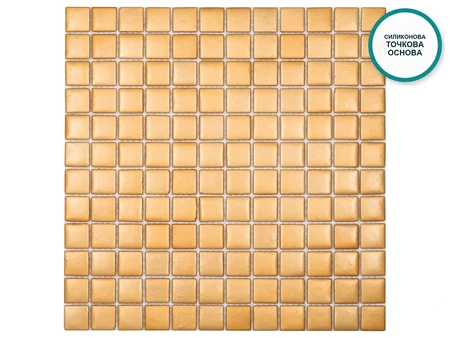
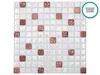
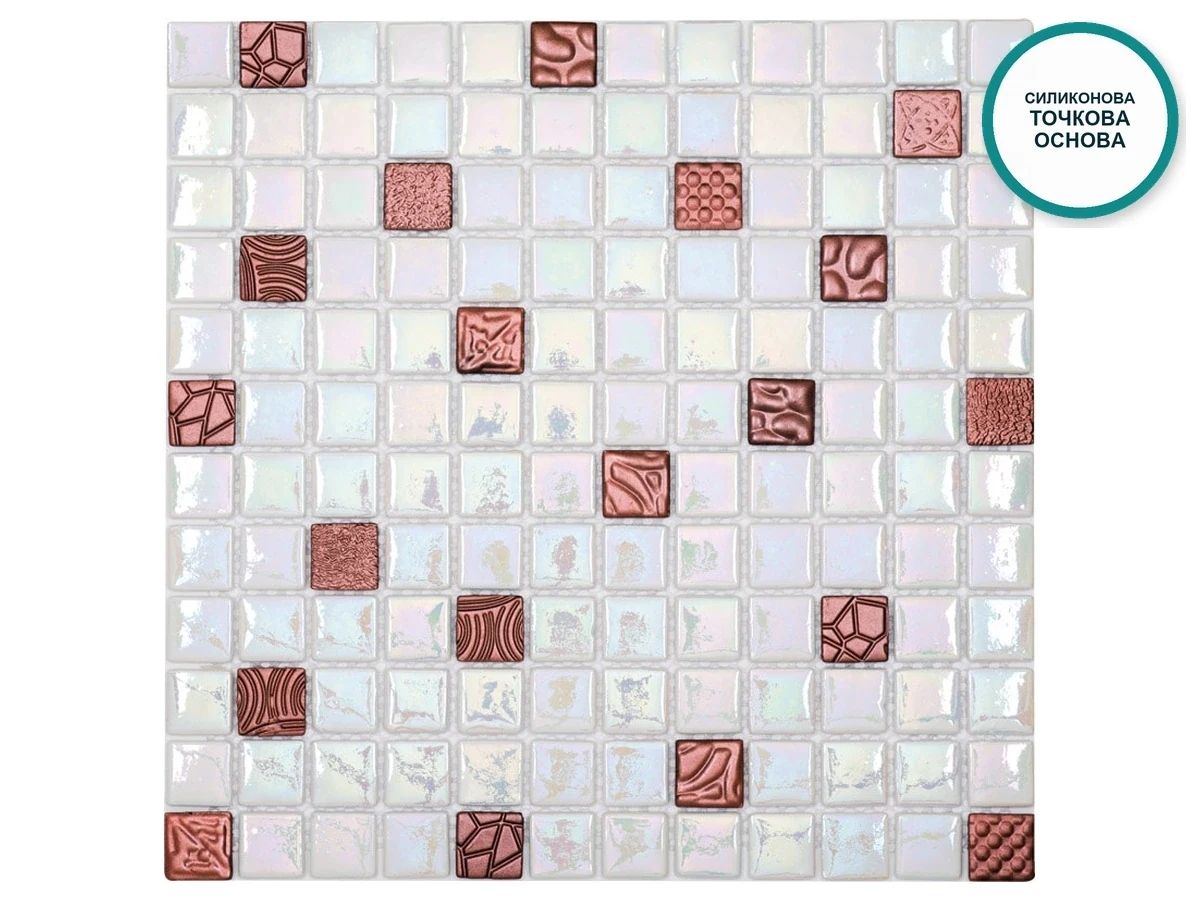
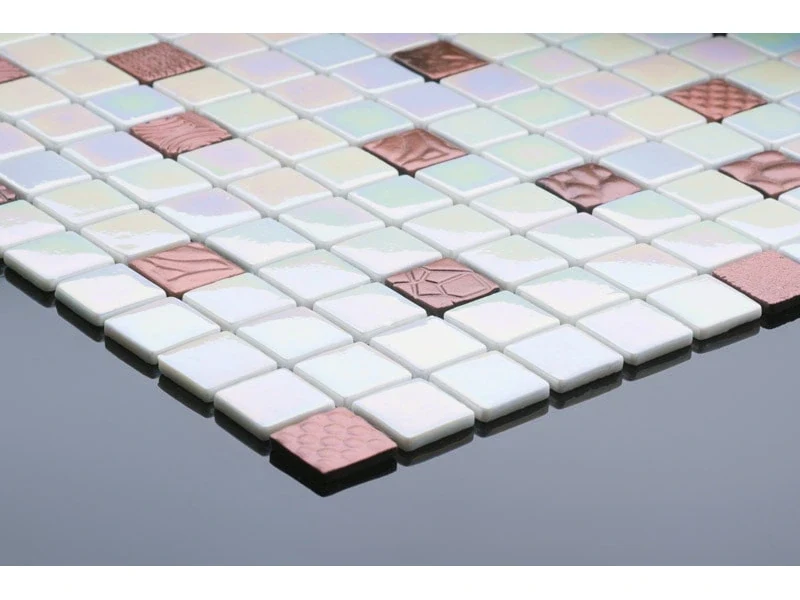
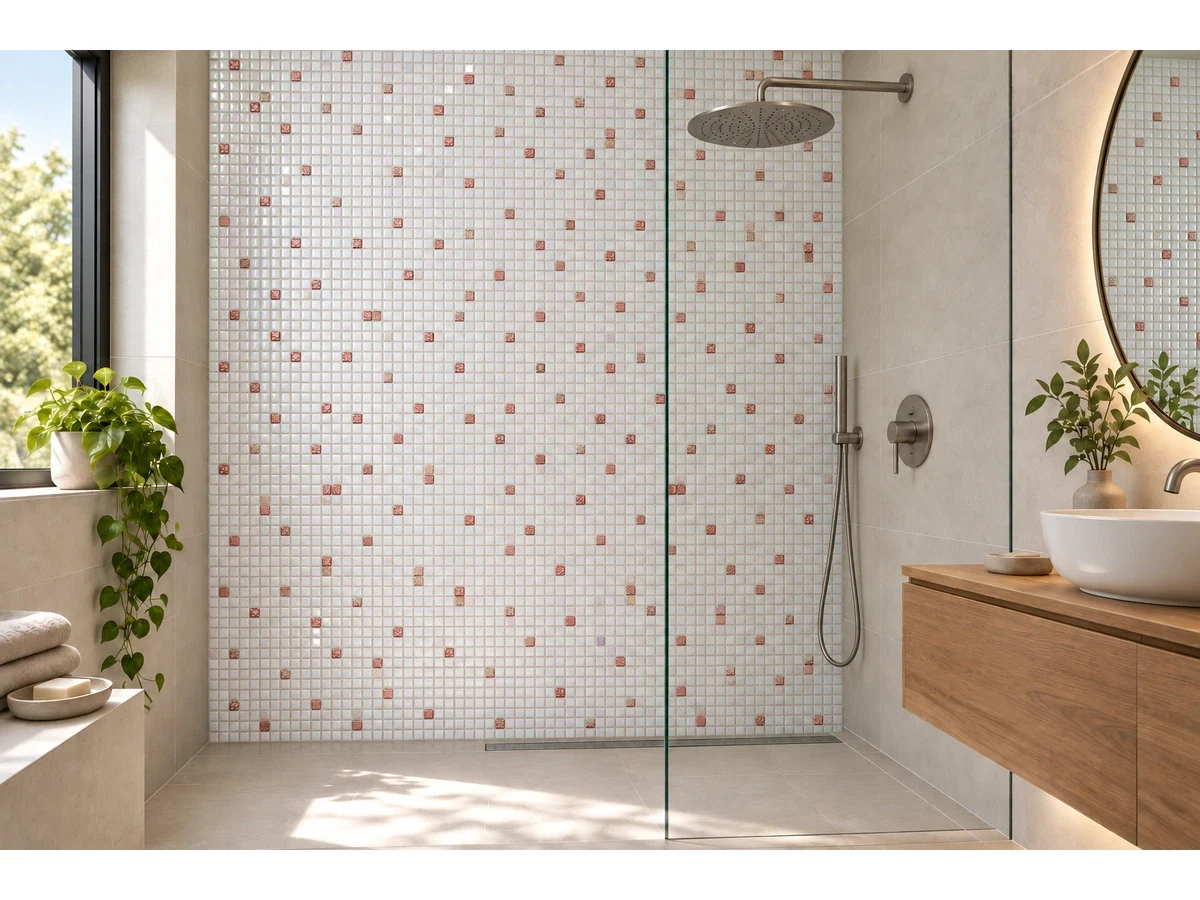
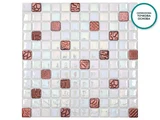
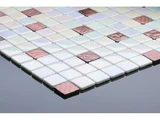
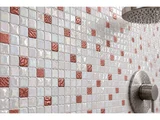
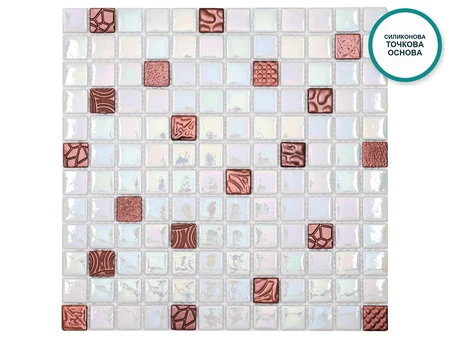
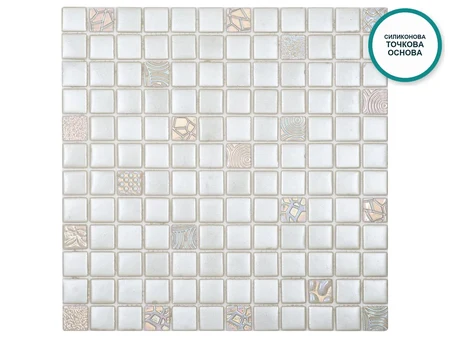
The glass-ceramic mosaic Rubellite has a pressed relief surface and square 25 × 25 mm chips. Its colour is pearlescent white with red-pink chips. Against the cool pearlescent white background, the red-pink chips glow like rubies set in white foam. The pink adds warmth, and in the sun under water it sparkles the most.
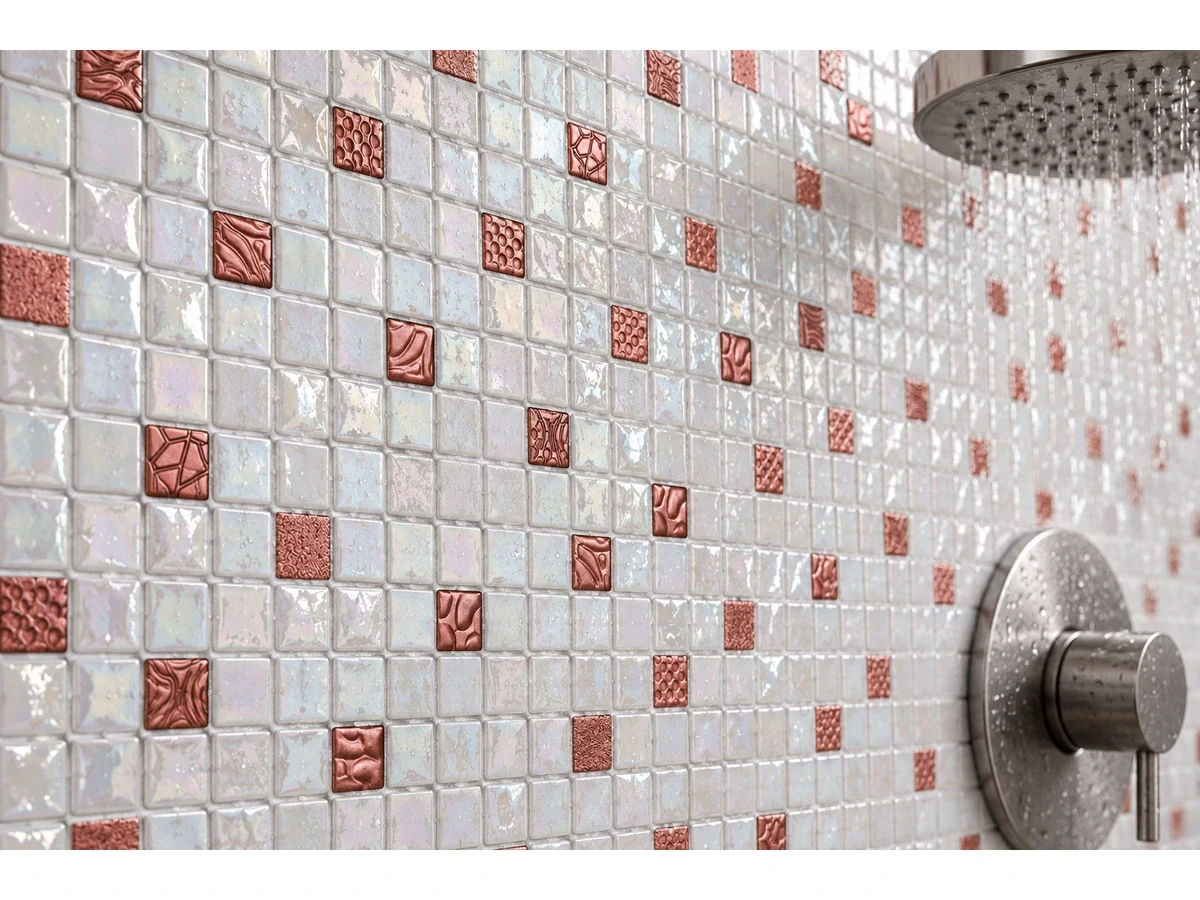
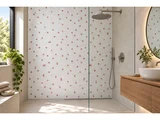
It suits a pool, bathroom and spa where a warm, gentle contrast is desired.
Why it is worth it
- Closed structure. Water absorption is up to 0.04%, so the surface does not collect mould, stains or odours.
- Lasting colour. Sunlight (ISO 4892) and cleaning agents (class A under ASTM C650) do not change it.
- Works outdoors too. It withstands freeze-thaw cycles under ASTM C1026.
- Strong and smooth. Flexural strength is 55 N/mm² (EN ISO 10545-4), and the surface is free of defects.
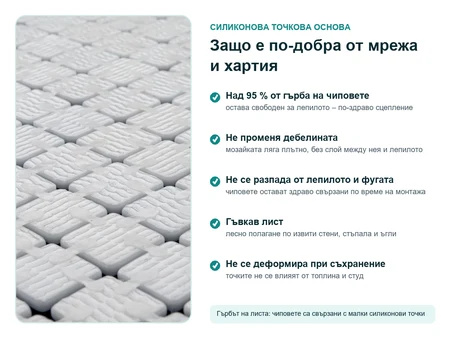
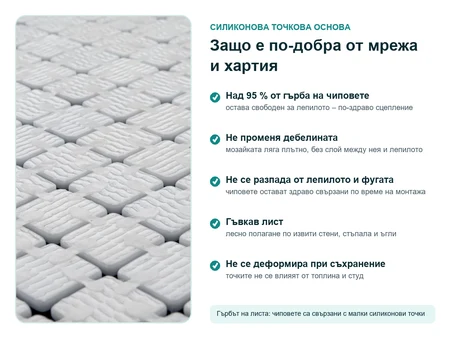
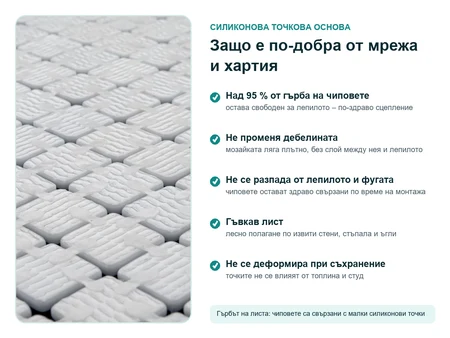
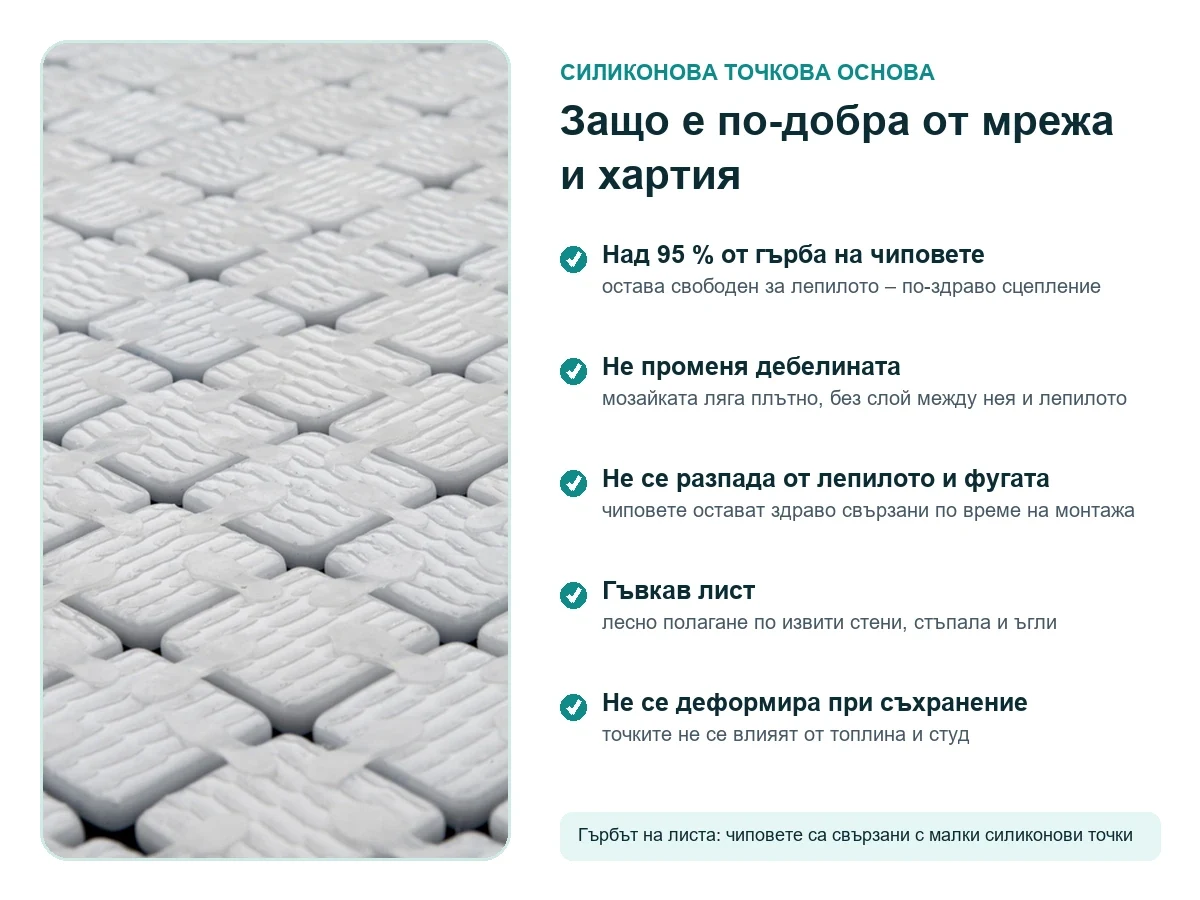
- Flexible sheet. The silicone dot backing gives good adhesion and allows installation on curved walls, steps and corners.
- Clean composition. It is made from recycled glass, without lead, cadmium or other heavy-metal pigments.
Technical specifications of Rubellite
| Model | Rubellite |
|---|---|
| Colour | pearlescent white with red-pink chips |
| Item code | MOSFBN206 |
| Sheet size | 317 × 317 mm |
| Sheets per square metre | 10 |
| Chip thickness | 4 mm |
| Size of one chip | 25 × 25 mm |
| Profile | square with a pressed relief surface |
| Raw material | glass ceramic made from 100% recycled glass |
| Sheet backing | silicone (polyurethane) dots |
| Joint width | 2 mm |
| Packaging | 1 m² carton |
| Unit of measure | 1 m² |
| Intended use | wall cladding in bathrooms, spas and hammams, shower cubicles, kitchens and decorative surfaces |
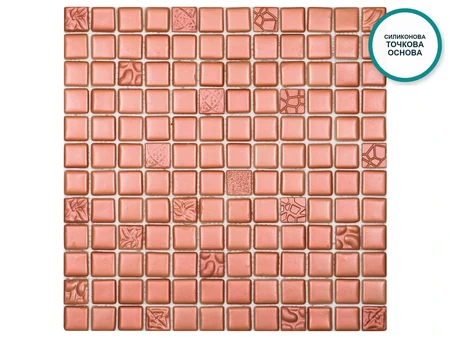
| Available colour shades | white, pink and red |
| Water absorption | maximum 0.04% (EN ISO 10545-3) |
| Flexural strength | 55 N/mm² |
| Frost resistance | withstands (ASTM C1026) |
| Chemical resistance | class A (ASTM C650) |
The silicone backing compared with mesh and paper
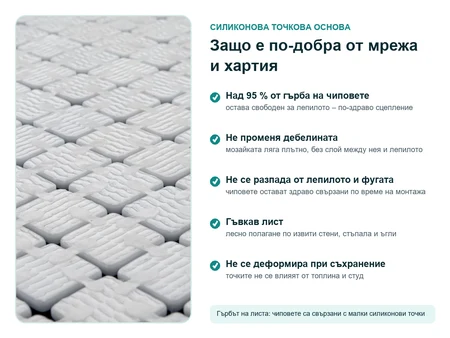
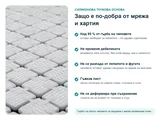
The Rubellite chips are connected at the back by small silicone (polyurethane) dots that do not cover their backs. This leaves more than 95% of every chip exposed to the adhesive, and adhesion is very good. The backing adds no thickness, is not damaged by the adhesive and grout, and does not warp in storage.
| Criterion | Silicone dots | Mesh | Paper |
|---|---|---|---|
| Back exposed to the adhesive | over 95% | less – part of the back is covered by the mesh | the whole back, but the paper is glued on the front |
| View during installation | chips and joints are visible | chips are visible | chips are hidden under the paper |
| Curved surfaces and corners | very easy, the sheet is flexible | easy | difficult, the paper tears |
| After bonding | nothing has to be removed | nothing has to be removed | the paper is soaked and peeled off |
Where to use it
- Walls in bathrooms and shower cubicles
- Kitchen wall behind the worktop
- Accent areas in spa centres, hotels and restaurants
- Decorative walls in pool rooms
Choosing a grout
White grout keeps the fresh look, while pink grout makes the chips stand out.
For shower cubicles and other damp areas, it is best to choose a C2 grout with waterproof properties or an epoxy grout – they do not absorb moisture and do not darken.
Installation steps
- Preparing the substrate. The surface must be dry, sound, dust-free and level (deviation of up to 2 mm over 2 m). In the shower area, waterproofing is applied first.
- Adhesive. Use a white flexible cement-based adhesive C2TE S1. The glass is slightly translucent, and a grey adhesive would dull the colour.
- Spreading. Cover an area for 2–3 sheets with a 3–4 mm notched trowel.
- Placing. Press the sheet in with a rubber float and leave the same 2 mm gap between the sheets.
- Cutting. At corners and openings, cut through the silicone dots with a utility knife and break off individual chips with glass mosaic nippers.
- Grouting. Wait a day. A suitable choice for shower areas is a water-protected C2 grout or an epoxy grout.
- Cleaning. Use a damp sponge to remove dirt from the grout while it is still soft; epoxy stains require a special cleaning product straight away.
- Putting into use. Turn the shower water on only when the grout has fully hardened.
Tools and materials
- bucket, sponge and water for cleaning
- rubber float plus a notched trowel with 3–4 mm teeth
- nippers for glass chips and a utility knife
- waterproof or epoxy grout
- class C2TE S1 adhesive in white
How much material to set aside
Work out the area by multiplying the height by the width of each wall and adding a little for cutting. For the adhesive, use about 2 kg per square metre when the chip is up to 25 mm; at 40 mm the figure is 2.5 kg, and for even larger elements it is 3 kg. The grout for this model (chip 25 × 25 mm, 4 mm thick, 2 mm gap) is calculated with the formula 1.6 × C × D × (A + B) / (A × B) kg/m². The figures are a guide only. In practice, the quantity is affected by the unevenness and absorbency of the substrate, the brand of adhesive and grout, the size of the trowel, the joint dimensions, the geometry of the pool or room and the experience of the installer. Therefore, confirm the calculations with the technical data sheets and with your installer.
Test results
| Standard | Parameter | Value |
|---|---|---|
| ISO 4892 | exposure to UV light | colour does not change |
| EN ISO 10545-2 | surface defects | none, 100% quality |
| EN ISO 10545-3 | water absorption | max. 0.04% |
| ASTM C650 | contact with chemicals | class A, no marks |
| EN ISO 10545-4 | breaking under bending | 55 N/mm² |
| ASTM C1026 | cyclic freezing | withstands |
| EN ISO 10545 | thermal expansion | withstands |
Caring for Rubellite
- Wash with a soft cloth or sponge and a neutral cleaning agent.
- Do not use abrasive powders, metal brushes or acids, which can damage the grout.
- After a shower, go over the surface with a silicone squeegee and the glass stays free of water spots.
Ordering tips
- The mosaic is sold in cartons of 1 m² each.
- It is best to take the whole quantity at once, with a 5–10% reserve, so that it comes from one production batch and has a uniform shade.
Questions and answers
Which adhesive is suitable?
We recommend a flexible C2TE S1 cement-based adhesive in white, because it does not change the colour of the glass.
Which grout should I choose?
In damp rooms, choose an epoxy grout or one with water resistance. White grout keeps the fresh look, while pink grout makes the chips stand out.
Can I buy less than one carton?
No, the mosaic is sold only in whole cartons of 1 m². Take the full quantity you need at once so that it comes from a single batch.
Is it suitable for salt and chlorinated water?
It is intended for walls and damp areas, and the glass does not react with cleaning agents.
Can it be laid over old tiles?
Yes, if they are sound, clean and degreased and have been treated with a suitable primer.
Why can the colour on site differ from the photos?
Glass is a natural material and looks different depending on the screen, the light, the viewing angle, the water in the pool, the colour of the grout and adhesive, the surrounding surfaces and the production batch. The visualisations are indicative, and if a particular shade matters, contact us before ordering.
See also: Wellness, Pools and Equipment, Cladding and Paving, Pools, Pool Chemicals, Pool Accessories.