

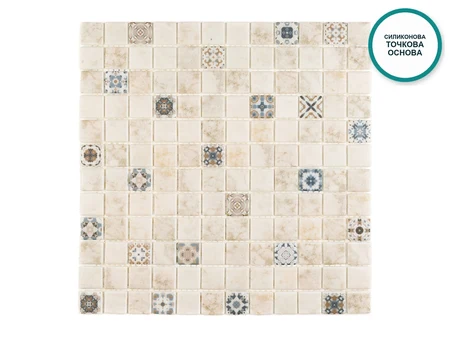
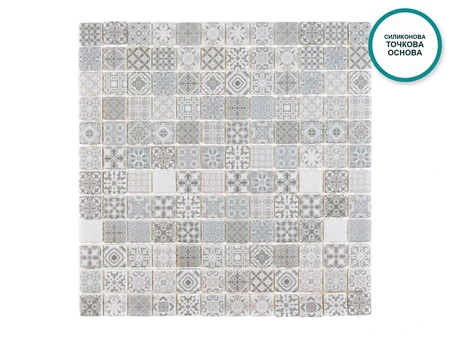
Description
Glass-ceramic patterned mosaic Pavia: overview
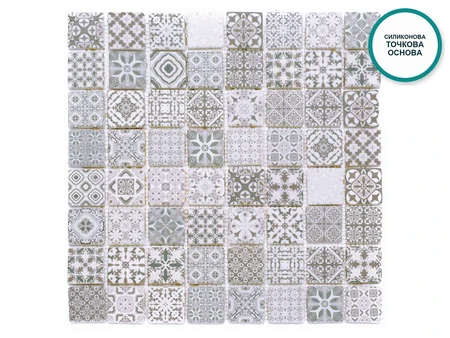
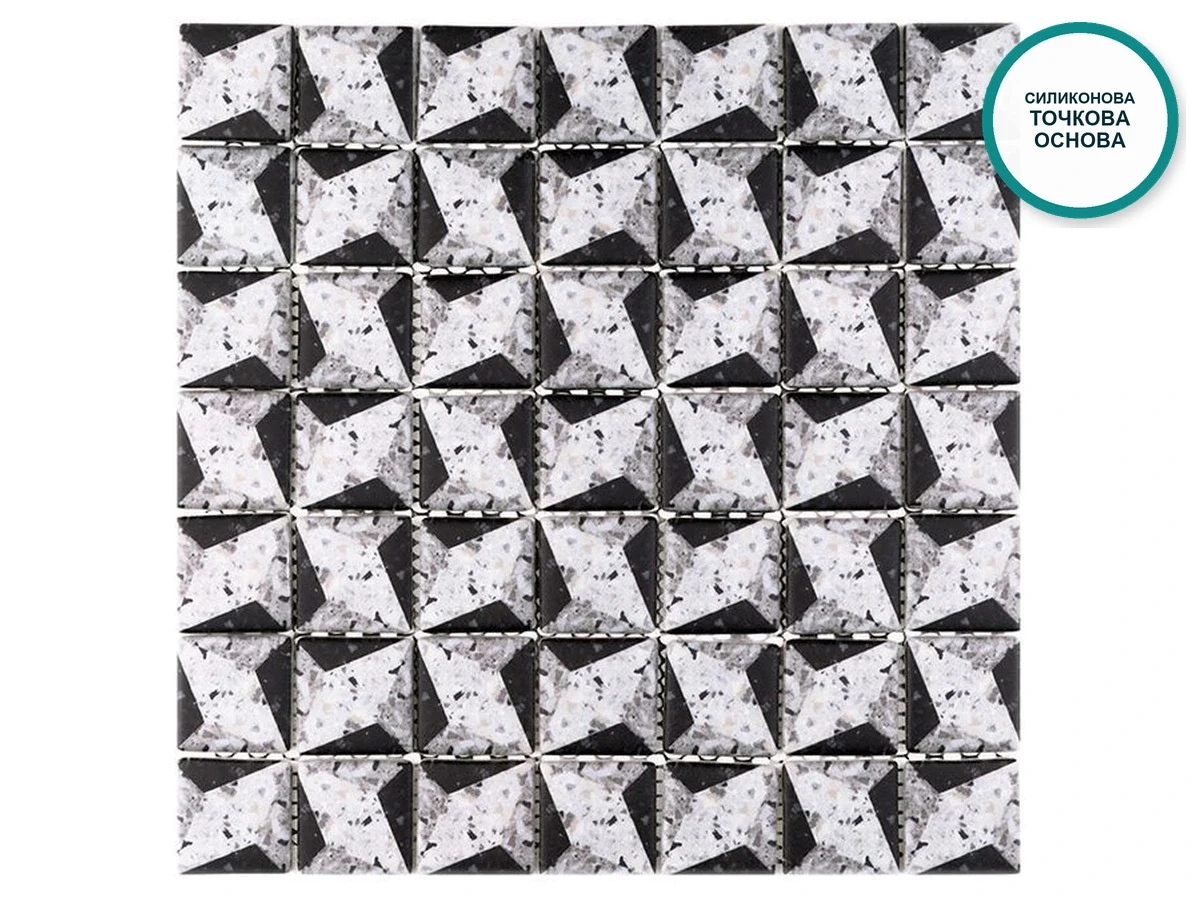
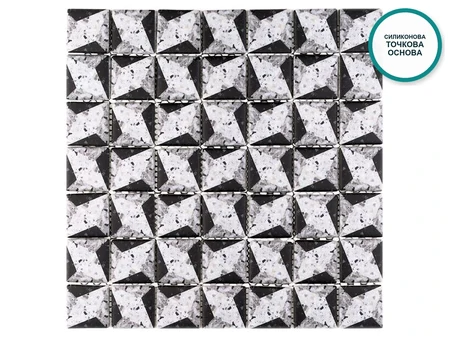
Pavia is a glass-ceramic wall covering for wet and dry rooms. The 50 × 50 mm chips are square, with a printed pattern, and the pattern is black and white with stars. The thickness is 6 mm and the sheet measures 340 × 340 mm, so one square metre takes 9 sheets. The item code is MOSFBZDJ018.
What Pavia looks like
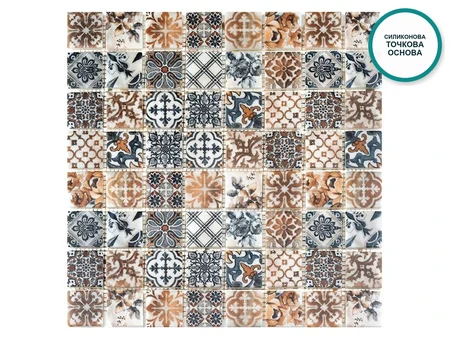
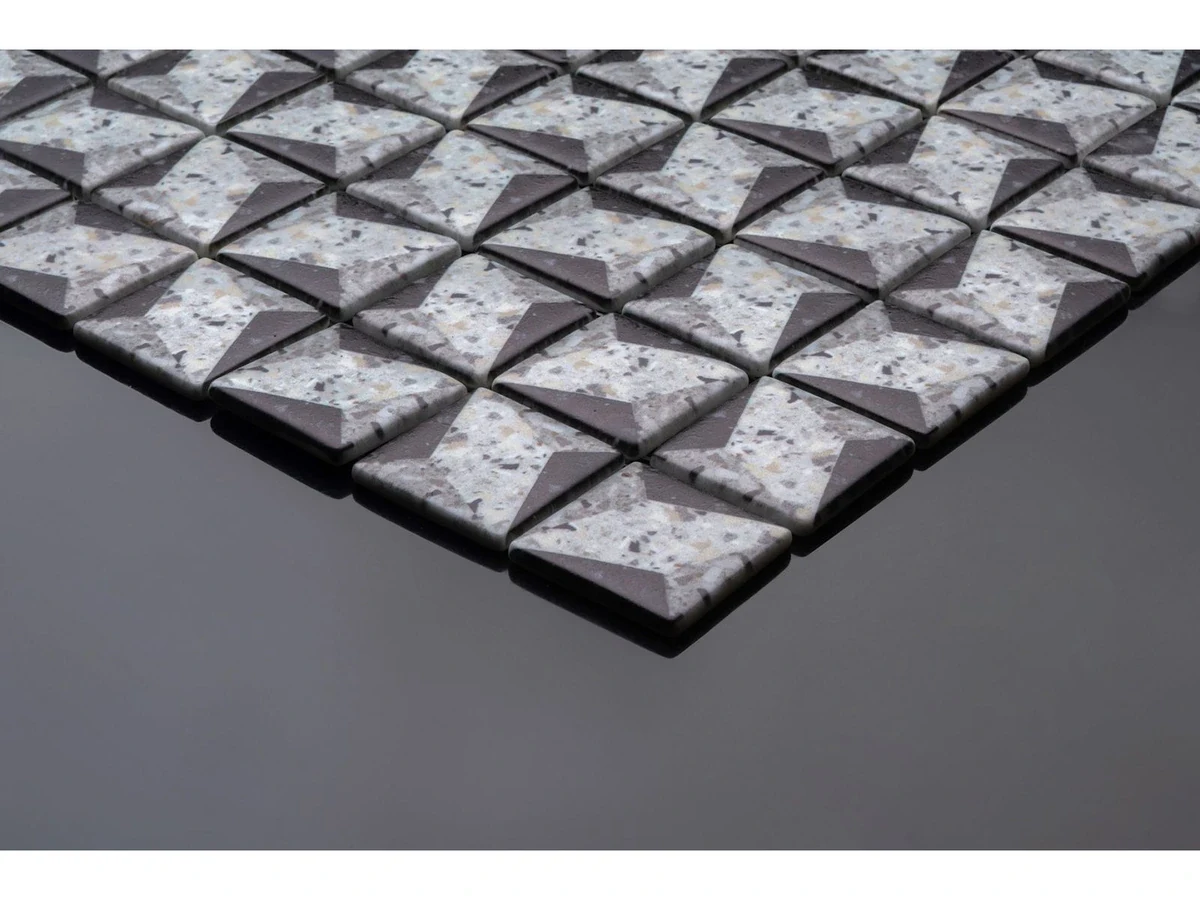
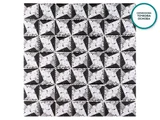
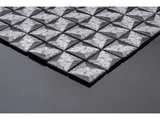
This is the most contrasting pattern in the series – sharp triangles on a light, finely grained field. They line up into spinning stars and create a sense of movement, like pinwheels.
In the catalogue the tone is listed as white and black. Because the material is glass-ceramic, it feels at home both in dry interiors and wherever there is constant moisture.
Key technical data
| Item code | MOSFBZDJ018 |
|---|---|
| Model | Pavia |
| Colour range | black-and-white pattern with stars |
| Chip shape | square with a printed pattern |
| Size of one chip | 50 × 50 mm |
| Mosaic thickness | 6 mm |
| Sheet size | 340 × 340 mm |
| Sheets per 1 m² | 9 |
| Composition | recycled glass (100 %), glass-ceramic |
| Chip fixing | silicone (polyurethane) dots |
| Grout width | 2 mm |
| Packaging | carton of 1 m² |
| Water absorption | no more than 0.04 % |
| Frost resistance | yes (ASTM C1026) |
| Flexural strength | 55 N/mm² |
| Chemical resistance | class A (ASTM C650) |
| Intended use | wall cladding in bathrooms, showers, kitchens, spa centres and hammams, decorative panels |
Why Pavia is worth it
- Non-porous surface. The glass absorbs no more than 0.04 % water, so mould does not settle on it and no stains or odours remain.
- Lasting colour. Sunlight (ISO 4892) and cleaning agents (class A under ASTM C650) do not change it.
- Frost-resistant. After freeze-thaw cycles (ASTM C1026) the material remains unchanged, which makes it suitable for outdoor areas too.
- Strength. The flexural strength is 55 N/mm² (EN ISO 10545-4), and the surface is free of defects.
- More reliable bonding. The silicone dots on the back hold better than mesh or paper and allow installation on curves and corners.
- A smaller footprint on nature. The raw material is entirely recycled glass (100 %), coloured without lead, cadmium or other heavy-metal pigments.
Silicone backing compared with mesh and paper
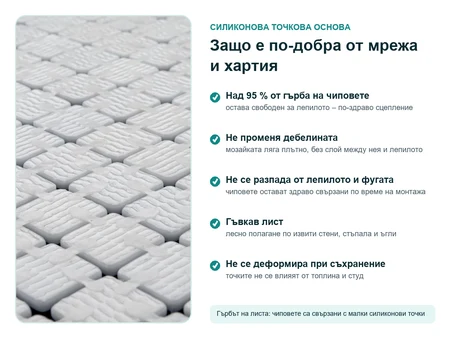
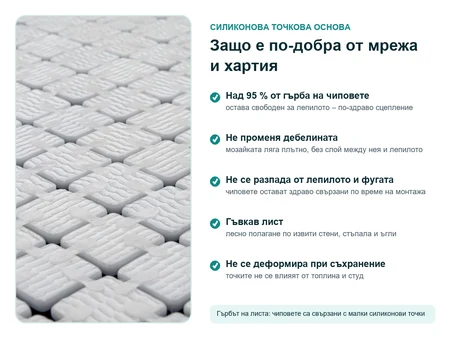
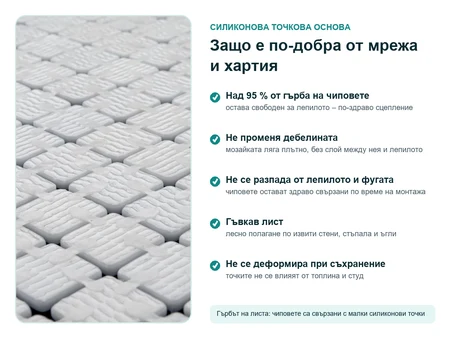
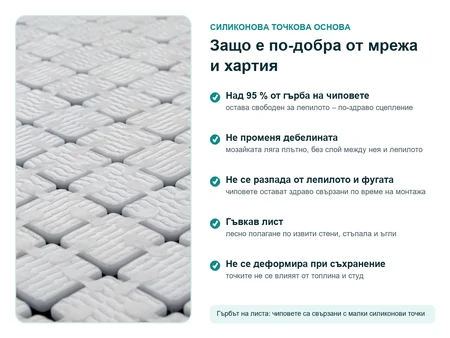
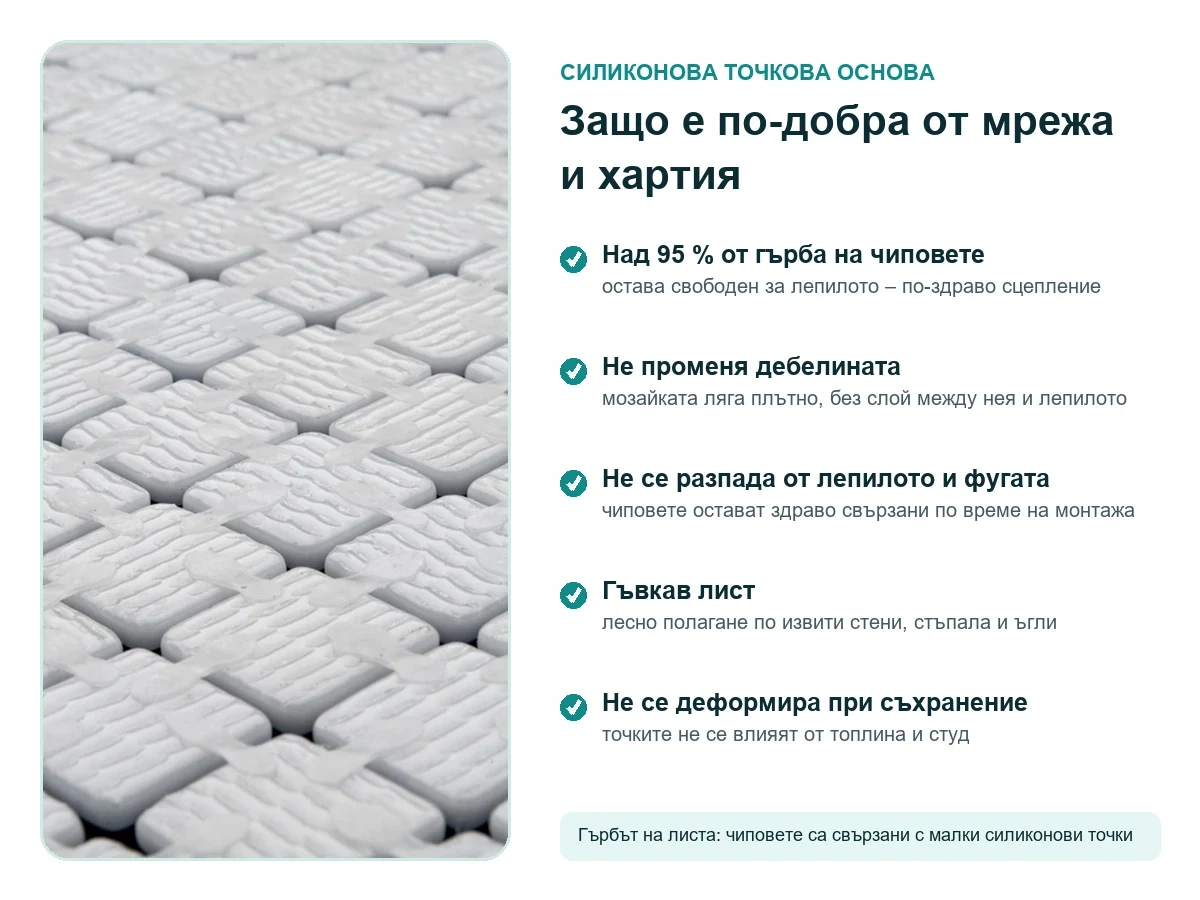
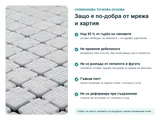
The chips in the sheet are joined at the back by small silicone (polyurethane) dots that do not cover the back of the chips. Over 95 % of the surface of each chip stays exposed to the adhesive, which is why the grip is very good. The backing adds no thickness, is not damaged by the adhesive and grout, and does not bend in storage. The sheet is flexible, so it follows curved walls, steps and corners.
| What is compared | Silicone dots | Mesh | Paper |
|---|---|---|---|
| Part of the back exposed to the adhesive | over 95 % | less, because the mesh covers part of the back | the whole back, but the paper is on the face side |
| What you see during installation | the chips and the joints | the chips | the chips are hidden under the paper |
| Curves and corners | extremely easy, the sheet is flexible | easy | difficult, the paper tears |
| After bonding | nothing to remove | nothing to remove | the paper is soaked and peeled off |
Where to use Pavia
- Kitchen backsplash with a clear contrast
- Bathroom
- Hallway
- Accent wall in a bathroom or spa area
- Panels and borders in the interior
Choosing the grout colour
A black grout strengthens the contrast, while a white one lightens the look of the stars.
For showers and any other wet area, choose an epoxy or waterproof C2 grout – it does not soak up water and does not darken over time.
How much material to plan for
First calculate the area: multiply the height by the width for each wall to be clad, and add an allowance for cutting to the total. The adhesive and grout rates are indicative. For the adhesive, count roughly 2 kg per m² for chips up to 25 mm, 2.5 kg for 40 mm and 3 kg for even larger chips. The grout is calculated with the formula (A + B) / (A × B) × C × D × 1.6 (kg/m²); here A and B are the sides of the chip, C is the thickness and D is the grout width, and for Pavia the chip is 50 × 50 mm, the thickness is 6 mm and the grout is 2 mm.
In practice, consumption varies with the condition of the substrate (smoothness, water absorption), the brand of adhesive and grout, the trowel chosen, the profile of the grout joint, the geometry of the site and the skill of the installer. Therefore check the quantities in the technical data sheets and agree them with your tiler.
Installation steps
- Preparing the substrate. The surface must be dry, sound, dust-free and level (deviation up to 2 mm over 2 m). In a shower area, waterproofing is done first.
- Choosing the adhesive. A white flexible cement-based adhesive C2TE S1 is suitable. The glass is slightly translucent and a grey adhesive would make the colour darker.
- Applying. The adhesive is spread with a 3–4 mm notched trowel over an area sufficient for 2–3 sheets.
- Bonding. The sheet is placed and pressed evenly with a rubber float. The same 2 mm joint is left between the sheets.
- Trimming. At corners and around fittings, the silicone dots are cut with a utility knife, and single chips are broken off with special glass mosaic nippers.
- Grouting. Wait 24 hours. For a shower area, an epoxy or waterproof C2 grout is the most suitable.
- Cleaning. Grout residue is removed with a damp sponge before it dries. Epoxy grout is cleaned immediately with a special cleaner.
- Putting into use. The shower is used once the grout has cured completely.
Materials and tools needed
- Adhesive: white, class C2TE S1
- Grout: epoxy or waterproof
- Notched trowel (3–4 mm teeth) and rubber float
- Utility knife and special nippers for cutting glass
- Clean water, a bucket and a sponge for the final cleaning
Tests to international standards
| Property | Value | Standard |
|---|---|---|
| Flexural strength | 55 N/mm² | EN ISO 10545-4 |
| Water absorption | no more than 0.04 % | EN ISO 10545-3 |
| Surface defects | none, 100 % usable surface | EN ISO 10545-2 |
| Chemical resistance | class A, no change | ASTM C650 |
| Freeze-thaw cycles | withstands | ASTM C1026 |
| UV exposure | no change | ISO 4892 |
| Thermal expansion | withstands | EN ISO 10545 |
Caring for the mosaic
- Wash with a soft cloth or sponge and a neutral cleaning agent.
- Do not use abrasive powders, wire brushes or acids, which damage the grout.
- After a shower, dry the wall with a rubber squeegee and the glass will leave no water marks.
How it is sold
- The mosaic is offered in cartons of 1 m² each, and the price is set per 1 m².
- We recommend taking the required quantity with a 5–10 % reserve in one order – this way all cartons come from the same batch and their tone matches.
Frequently asked questions
What adhesive should Pavia be installed with?
With a white flexible cement-based adhesive C2TE S1, which does not change the colour of the glass.
Which grout is suitable?
For wet rooms – epoxy or waterproof. A black grout strengthens the contrast, while a white one lightens the look of the stars.
Can I buy less than one carton?
No, sales are by whole cartons of 1 m². Buy the whole quantity at once so that it comes from one batch.
Is it suitable for a pool with salt water and chlorine?
The mosaic is intended for walls and wet areas, and the glass does not react with cleaning agents.
Can it be bonded onto old tiles?
Yes, provided that the old tiles are sound, clean and degreased, and primed with a suitable primer.
Why the colour on site may differ from the photo
Glass mosaic changes its appearance with the conditions, so the real colour may differ from photos and visualisations. The influences are:
- the calibration, brightness and type of the screen;
- the light – direct sun, cloudy weather, artificial lighting, the colour of the lamps, the time of day;
- the viewing angle, because glass reflects differently;
- the water in the pool: its depth, clarity and chemical composition, as well as the reflected sky, deepen the shade and make it bluer;
- the chosen grout and adhesive, as well as the size of the clad area;
- the surrounding colours – coping, paving, walls, vegetation;
- the production batch, where the shade may differ slightly, which is why the quantity is taken at once;
- the inherent differences from chip to chip when the glass is mixed or has an effect.
The illustrations with pools and rooms are indicative – they give only an idea of the final look.
How many cartons are needed
If you send us the dimensions of the pool or room, we will calculate the square metres and the number of cartons before you order.
See also: Wellness, Pools and Equipment, Cladding and Paving, Pools, Pool Chemicals, Pool Accessories.