

Description
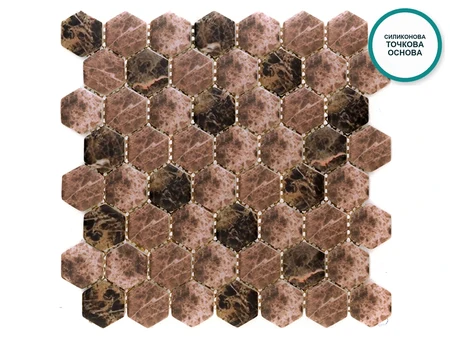
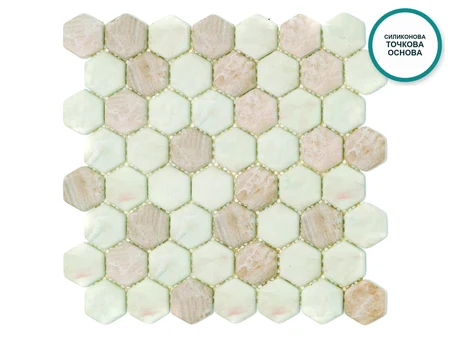
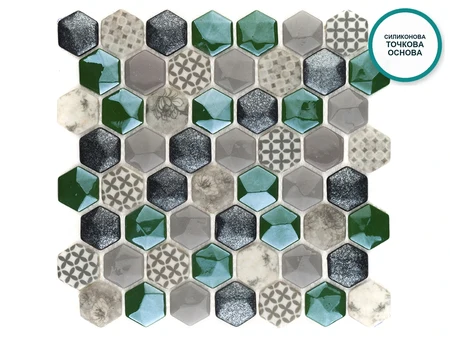
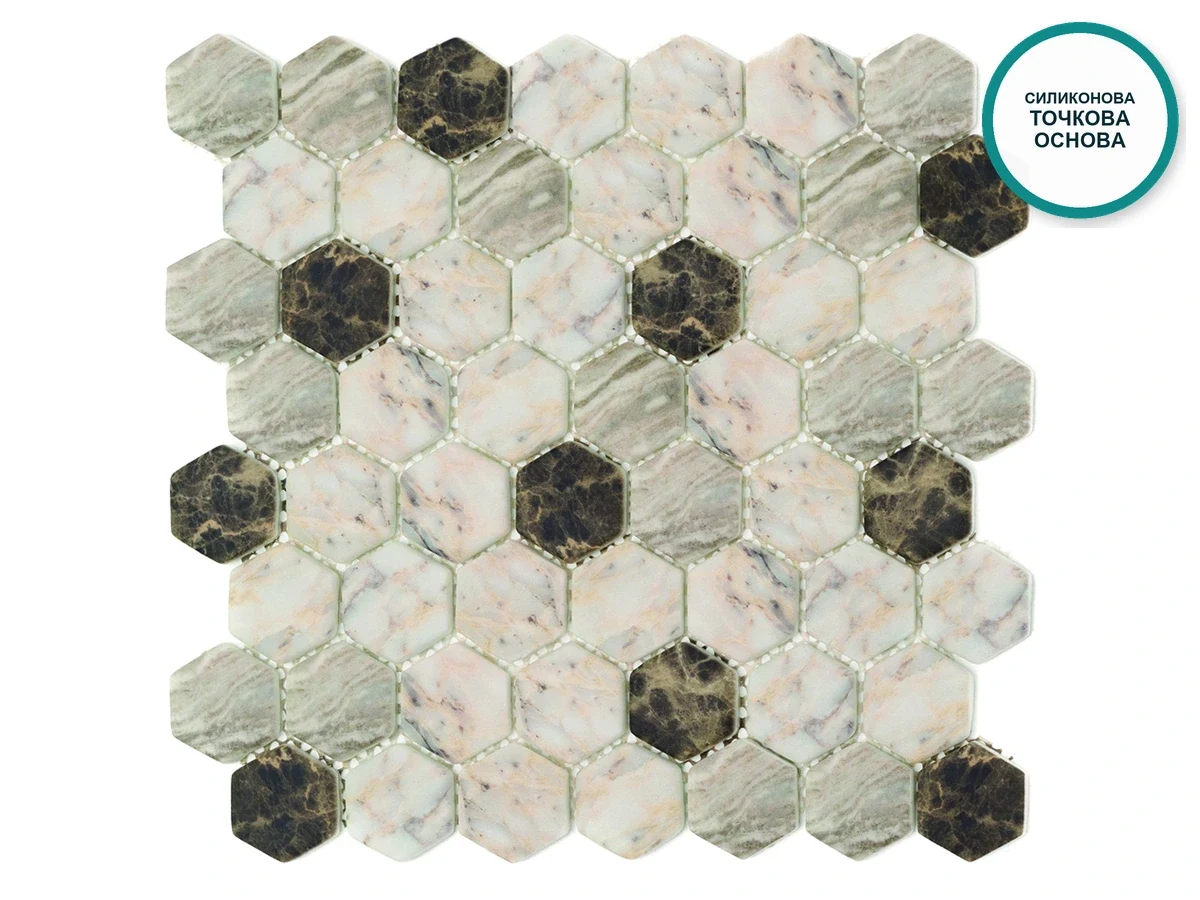
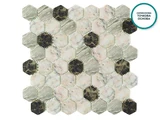
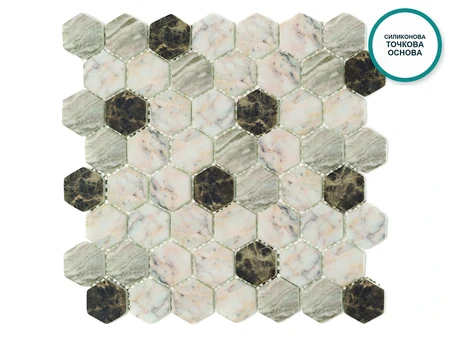
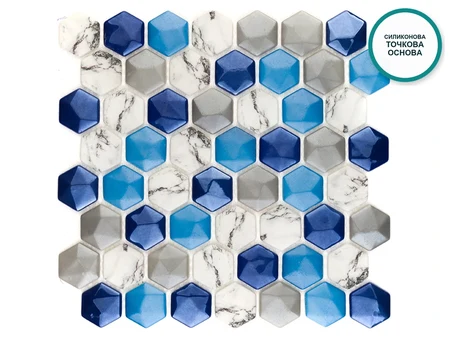
Emperador mosaic: hexagonal chips in grey-brown with dark hexagons
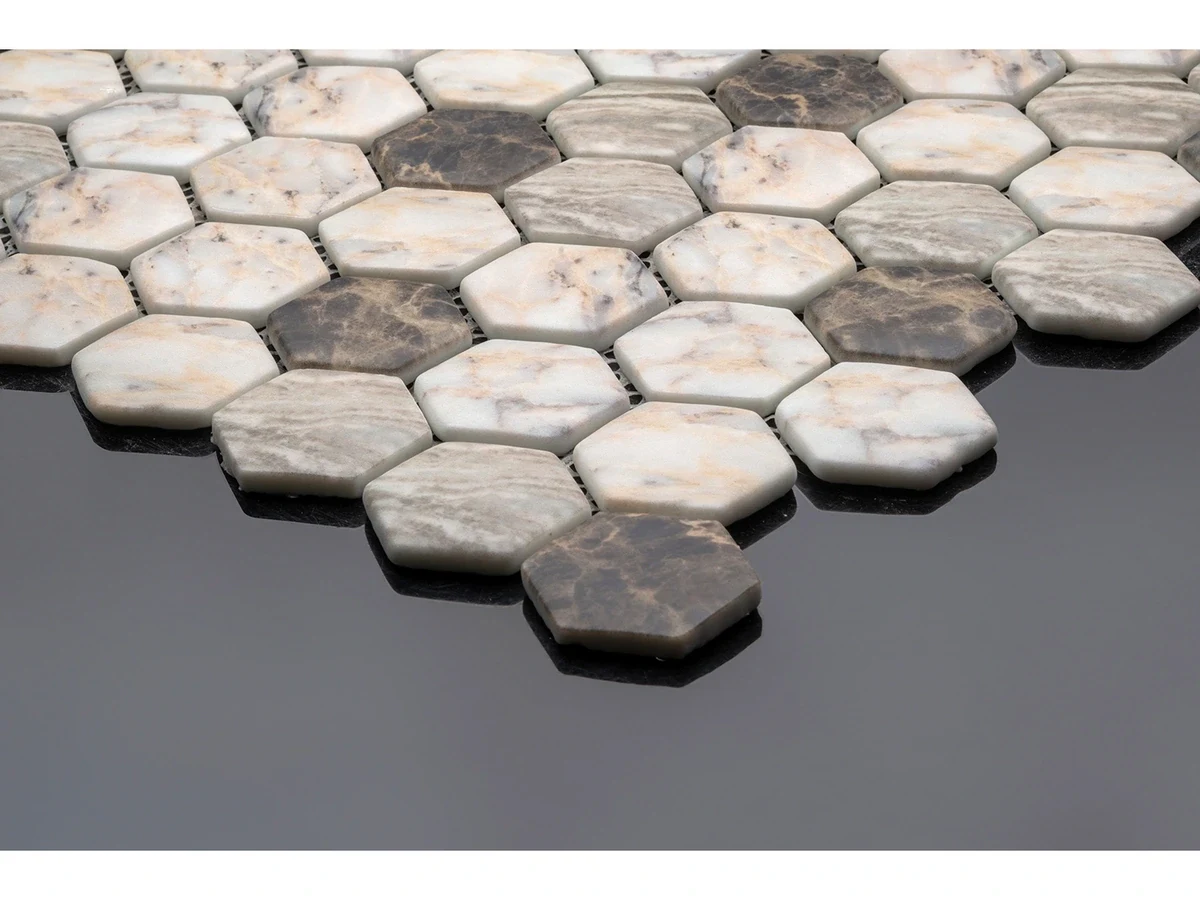
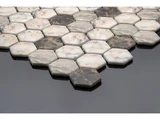
Emperador is a glass-ceramic wall cladding for bathrooms, shower cubicles, kitchens, spa areas and hammams. The hexagonal tiles carry a printed design – grey-brown with dark hexagons – and the surface effect (gloss) plays with light and water, adding depth.
The mix of grey-brown hexagons with dark pieces recalls Emperador marble: the shades are warm and earthy, with white veining. It suits refined bathrooms and spa areas with a refined character, and creates a calm, luxurious look.
Why this mosaic
- Non-porous surface: water absorption of up to 0.04 %, so there is no mould, staining or odour.
- Lasting colour: it does not fade in sunlight (ISO 4892) or when exposed to cleaning products (class A per ASTM C650).
- Frost resistance: it withstands freeze–thaw cycles (ASTM C1026), so it is also suitable for outdoor areas.
- Strength: flexural strength of 55 N/mm² (EN ISO 10545-4) and a smooth, defect-free surface.
- Clean composition: all the glass is recycled, and the colourants contain no lead, cadmium or other heavy metals.
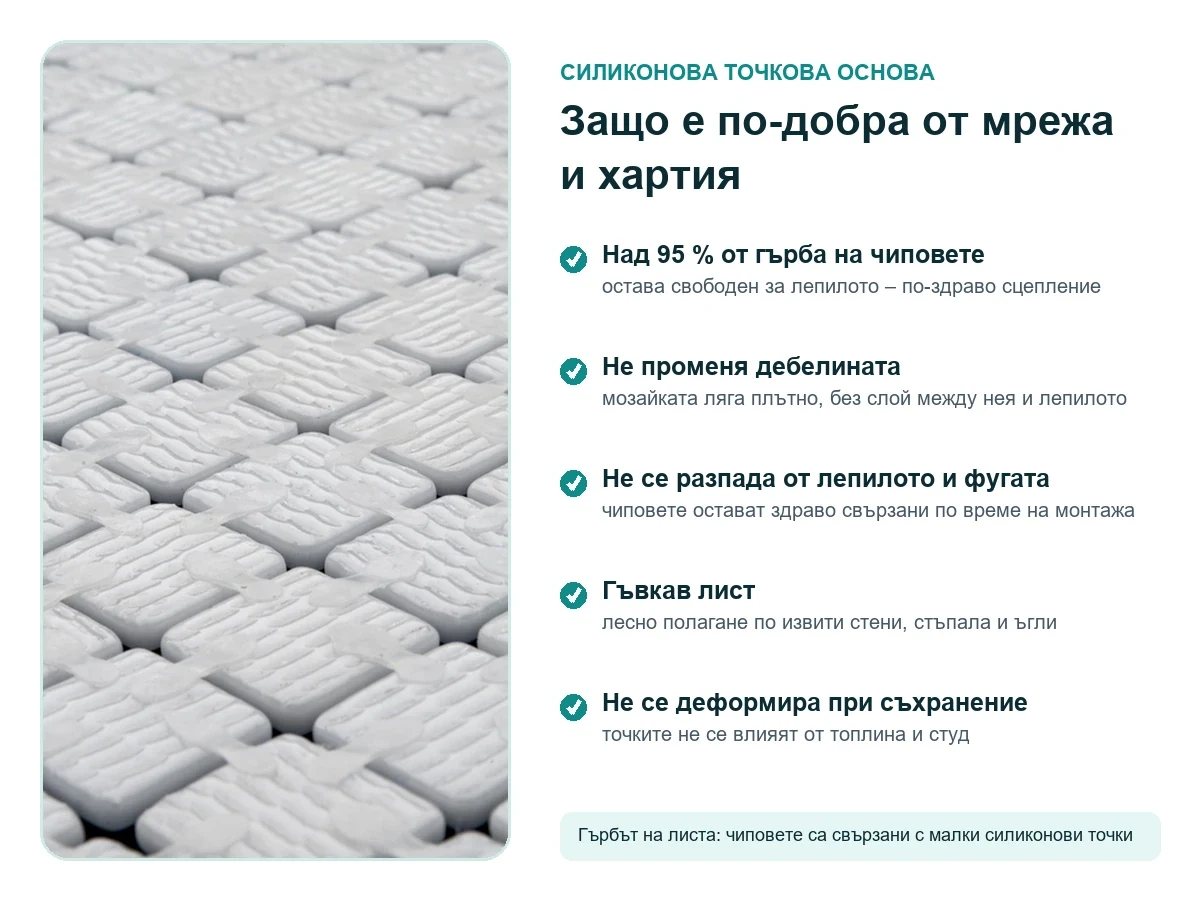
- Easy installation: the silicone dot backing holds the chips together and allows laying around curves and corners.
The model at a glance
| Characteristic | Data |
|---|---|
| Item number | MOSFBDJ008 |
| Sheet format | 300 × 290 mm; 13 sheets cover 1 m² |
| Chip | hexagonal, with a printed design |
| Composition | glass ceramic made from 100 % recycled glass |
| Colouring | grey-brown with dark hexagons; main tones: brown and grey |
| Look | gloss |
| Sheet backing | silicone (polyurethane) dots |
| Spacing between chips | 2 mm joint |
| Water absorption | maximum 0.04 % (EN ISO 10545-3) |
| Flexural strength | 55 N/mm² |
| Frost and thaw | withstands, ASTM C1026 |
| Chemical resistance | ASTM C650, class A |
| Suitable environment | bathroom, shower cubicle, kitchen, spa, hammam, decorative wall |
| Sales unit | carton of 1 m² (quantities are multiples of the carton) |
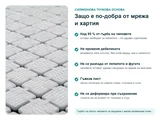
Silicone dot backing instead of mesh or paper
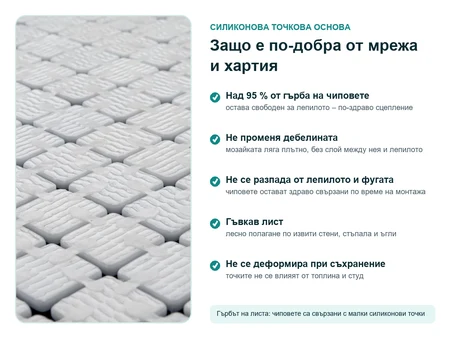
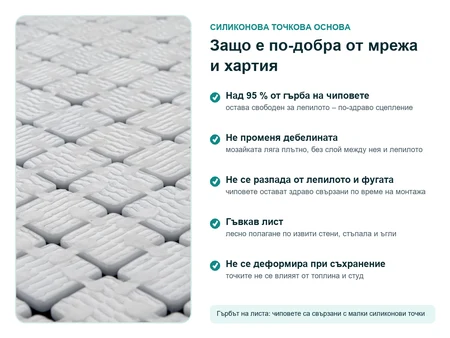
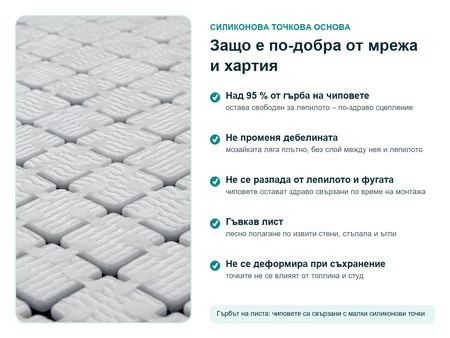
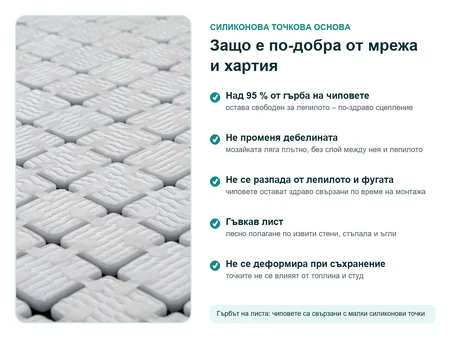
At the back, each chip is joined to its neighbours by small silicone (polyurethane) dots. They leave more than 95 % of the chip's rear surface free, so the adhesive covers it almost completely and the bond is more secure. The dots do not make the mosaic any thicker, the adhesive and grout do not attack them, and the sheets do not warp in storage. Thanks to the flexible sheet, the mosaic easily follows curved surfaces, steps and inside corners.
- Mesh covers part of the back of the chips; paper is glued to the front and hides the pattern while you work, and afterwards it has to be soaked and peeled off.
- Silicone dots hide neither the face nor the back – you see the chips and joints as soon as you lay out the sheets, and there is nothing to remove afterwards.
Where to use it
- a refined bathroom or spa area in earthy tones
- shower cubicles and wet areas in bathrooms
- decorative panels in spa centres, hotels and restaurants
Choosing the grout
A beige grout keeps the warmth of the colours, while a dark brown one highlights the dark pieces. In shower cubicles and other wet areas it is best to use an epoxy or waterproof C2 grout, which does not absorb moisture and does not darken.
Installation steps
- Substrate: a dry, sound, dust-free surface with an unevenness of no more than 2 mm per 2 m. Waterproofing is applied before a shower area.
- Adhesive: use a white flexible cement-based adhesive C2TE S1. The colour matters – through the translucent glass, a grey adhesive would change the tone of the mosaic.
- Spreading: a notched trowel (3–4 mm teeth) spreads the adhesive over an area big enough for two or three sheets.
- Laying: each sheet is set in place and pressed flat with the rubber float; the same 2 mm joint is kept between the sheets.
- Trimming: at corners and around openings, the dots between the chips are cut with a sharp knife, and the chips themselves are shaped with special nippers.
- Grouting: wait a day. In the shower, epoxy and waterproof compounds of class C2 are the most suitable.
- Cleaning off: excess grout is wiped away with a damp sponge while it is still soft; epoxy requires immediate action with a special cleaner.
- Putting into use: water may be turned on only after the grout has fully cured.
What to prepare
- white adhesive C2TE S1;
- waterproof C2 grout or epoxy grout;
- a notched trowel with 3–4 mm teeth and a rubber float;
- a hobby knife and special nippers for glass mosaic;
- a bucket, a sponge and clean water.
How much material to buy
Multiply the height by the width of each wall to be tiled, add up the areas and increase the result by 5–10 % for cutting waste. Buy the whole quantity at once – that way the sheets come from the same batch. A guide for the adhesive: ~2 kg per square metre for chips up to 25 mm, ~2.5 kg for 40 mm and ~3 kg for larger ones. The grout is calculated with (A + B) / (A × B) × C × D × 1.6 kg/m² – for a chip of about 3 cm, a thickness of about 6 mm and a joint of 2 mm. The exact consumption varies with the smoothness and absorbency of the substrate, the products chosen, the tools and the skill of the installer, so check the technical data sheets.
Tests to standards
- EN ISO 10545-2: the surface is free of defects (100 %).
- EN ISO 10545-4: in bending it withstands a load of 55 N/mm².
- ISO 4892: after UV exposure the colour does not change.
- ASTM C650: for chemical resistance the material is class A and does not change.
- ASTM C1026: it passes the freeze–thaw test.
- EN ISO 10545: it also tolerates temperature changes (thermal expansion).
- EN ISO 10545-3: it absorbs at most 0.04 % water.
Caring for the surface
- For everyday cleaning, a soft cloth or sponge and a neutral cleaning product are enough.
- Keep away from abrasive powders, wire brushes and acidic solutions.
- A rubber squeegee after bathing keeps the surface free of water spots.
Frequently asked questions
Which adhesive should be used? A white flexible cement-based adhesive C2TE S1 – it preserves the exact colour of the glass.
Can it go over old tiles? Yes, if they are sound, clean, degreased and primed with a suitable primer.
Is it meant for salt water and chlorine? The product is for cladding walls and damp rooms; cleaning agents do not affect the glass.
What exactly is the quantity in a pack? The mosaic is bought in multiples of a 1 m² carton.
Difference between the screen and the real look
Glass is a lively material and its colour is perceived differently under different conditions, so the photo and the mosaic on site may differ. The settings and type of screen, natural and artificial light, the viewing angle, the colour of the grout and adhesive, surrounding surfaces and differences between production batches all have an influence. The visualisations are for guidance only.
See also: Wellness, Pools and Equipment, Cladding and Paving, Pools, Pool Chemicals, Pool Accessories.