

Description
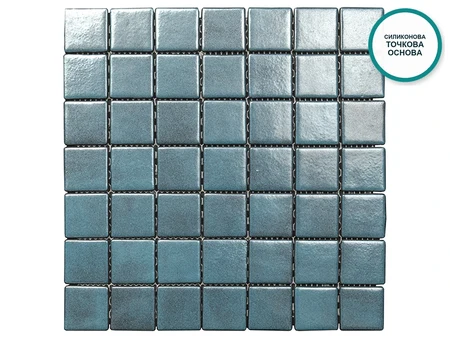
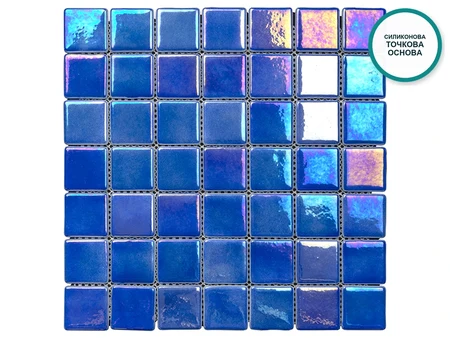
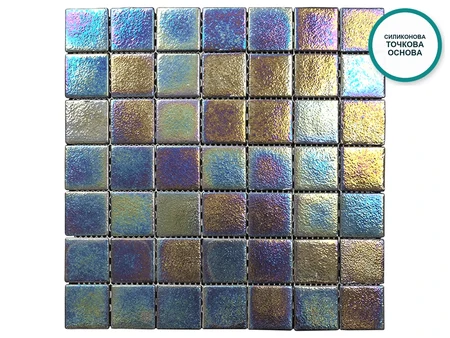
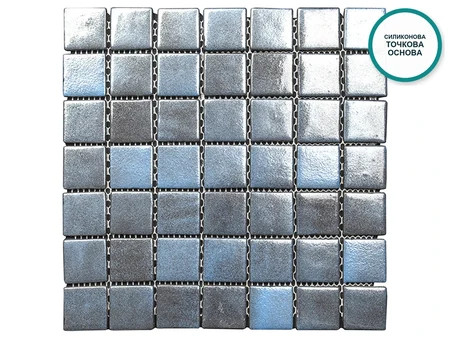
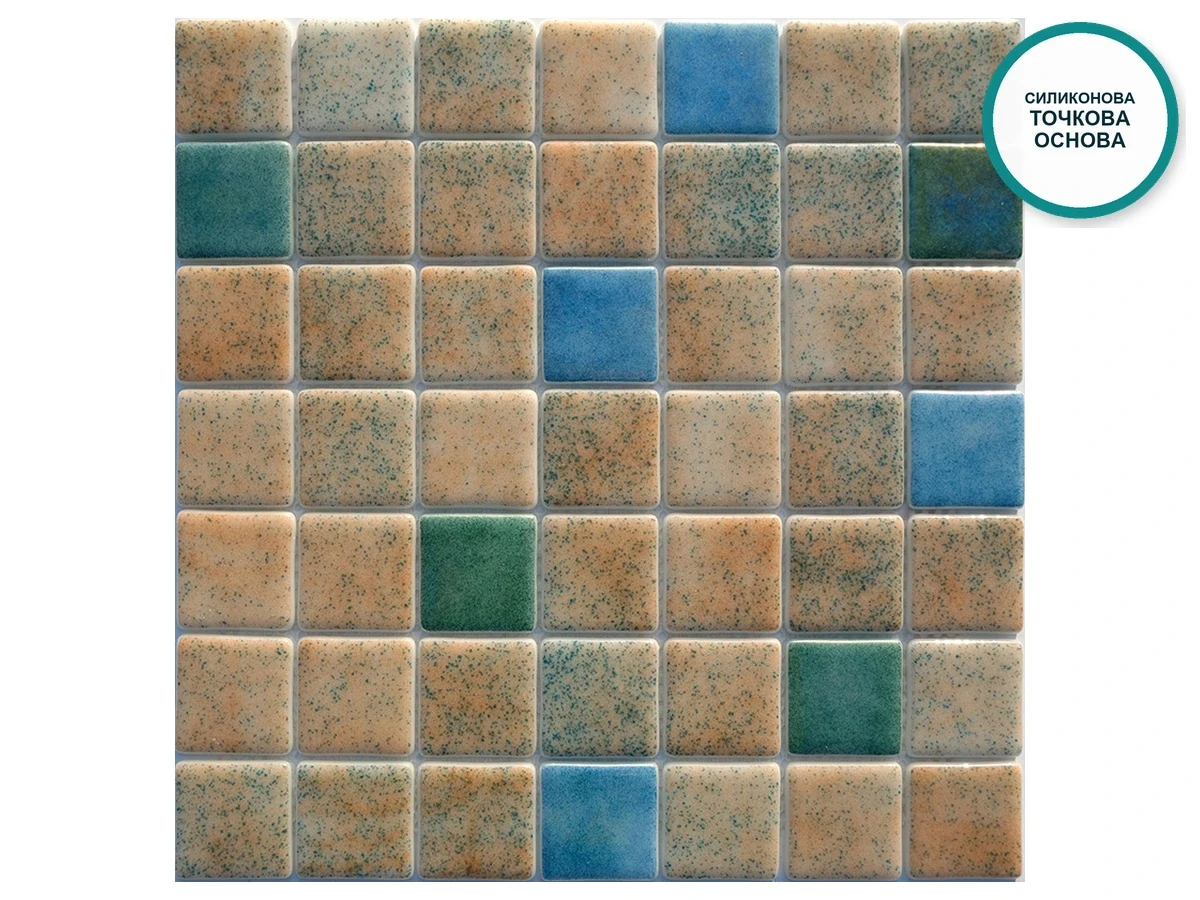
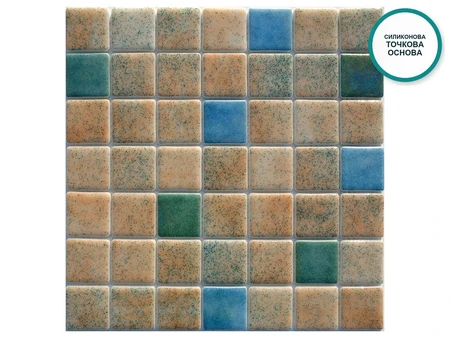
Cala Agulla Mosaic is a glass-ceramic bathroom and spa lining in the colour “sand-beige with blue and green pieces”. The square chips measure 50 mm on each side and are 6 mm thick, mounted on 340 × 340 mm sheets that are quick and easy to lay. The article number is MOSFBZB266.
The Character and Colour of Cala Agulla
The warm sandy base is flecked with blue and green pieces that stand out like pebbles on a beach. The lining looks lively and natural and brings a summer mood to showers, bathrooms and spa areas.
Choosing the Grout
Beige grout keeps the sandy look, while white grout emphasises the coloured pieces. In shower cubicles and other wet areas, use an epoxy or waterproof C2 grout, which does not absorb moisture and does not darken.
Advantages of Glass Ceramic
- Non-porous surface: water absorption is up to 0.04%, so there is no mould, staining or odour.
- Lasting colour: it does not fade in the sun (ISO 4892) and resists cleaning agents (class A under ASTM C650).
- Frost-resistant: it withstands repeated freezing and thawing (ASTM C1026), so the lining can also be used outdoors.
- Strong: in testing under EN ISO 10545-4 it withstands a bending load of 55 N/mm², and the face is smooth and flawless.
- Flexible sheet: the silicone-dot backing gives good adhesion and allows installation on curved walls, steps and corners.
- Eco-friendly: made entirely from recycled glass, with no lead, cadmium or other heavy metals in the colourants.
Technical Specifications
| Parameter | Value |
|---|---|
| Article | MOSFBZB266 |
| Shade | sand-beige with blue and green pieces |
| Chip | square, 50 × 50 mm, height 6 mm |
| Sheet | 340 × 340 mm |
| Gap between sheets | 2 mm |
| Composition | recycled glass (100%), glass ceramic |
| Sheet backing | polyurethane (silicone) dots |
| Water absorption | ≤ 0.04% (EN ISO 10545-3) |
| Bending | withstands 55 N/mm² |
| Frost | resistant – ASTM C1026 |
| Chemicals | class A – ASTM C650 |
| Intended use | bathrooms, shower cubicles, kitchens, spa areas, hammams and decorative walls |
| Packaging | carton of 1 m² |
Why Silicone Dots Instead of Mesh or Paper
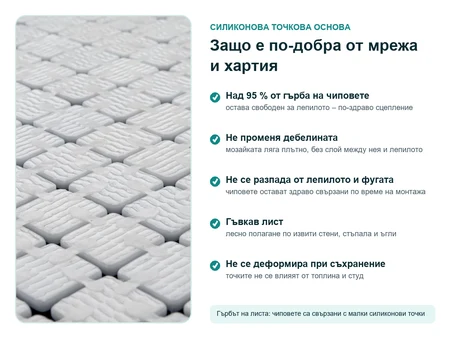
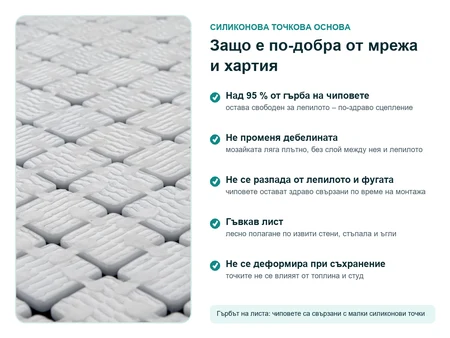
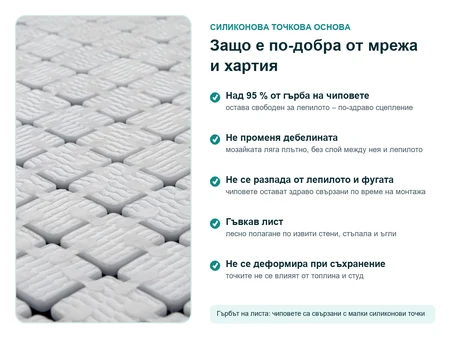
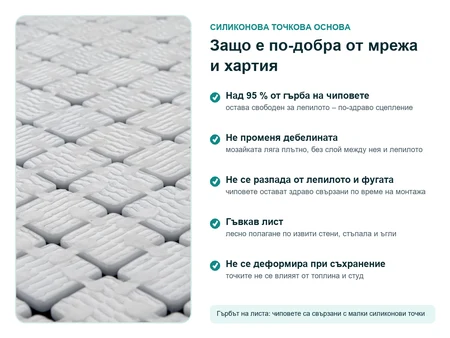
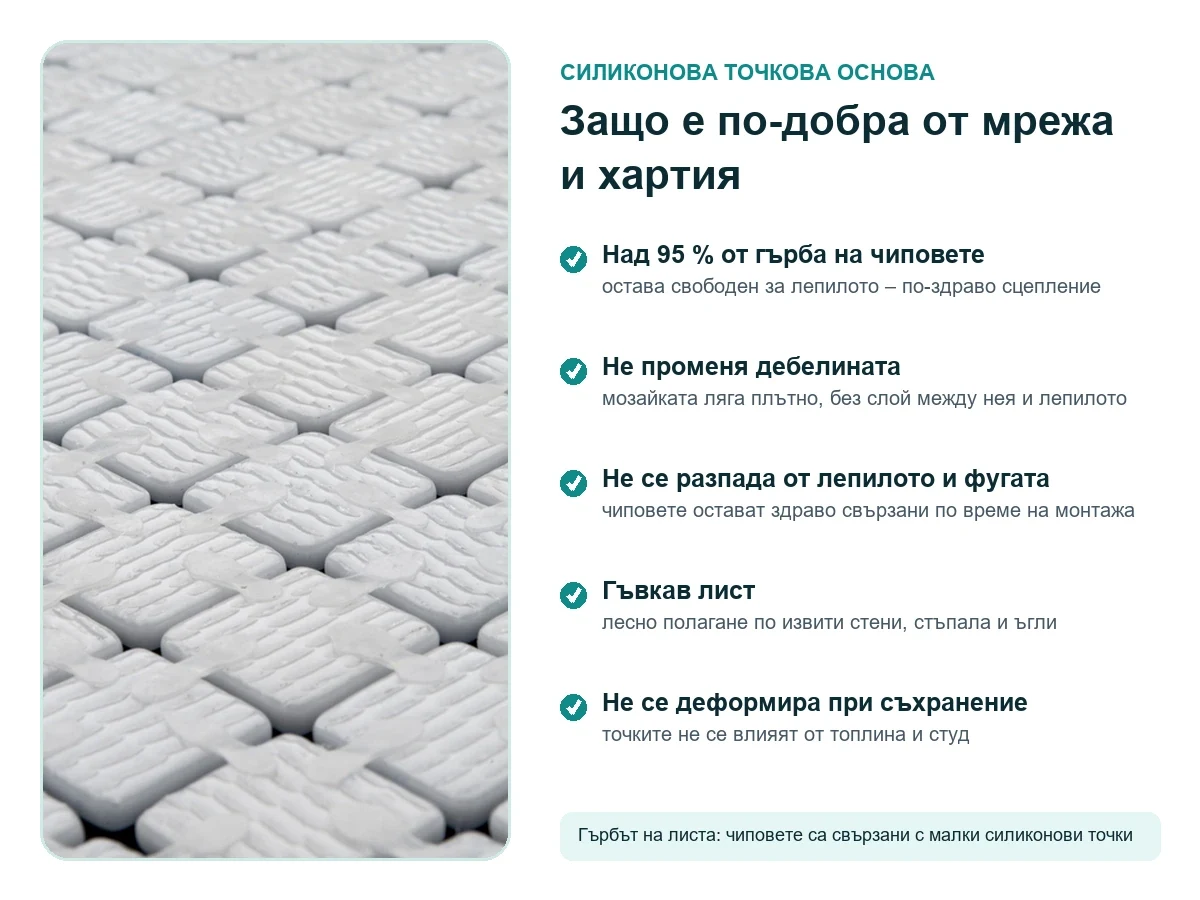
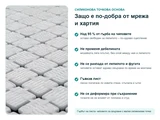
Cala Agulla sheets come on a flexible silicone (polyurethane) dot backing. The small silicone dots hold the chips together without covering their backs, so over 95% of each chip stays free for the adhesive. The thickness of the mosaic remains unchanged, and the backing withstands contact with adhesive and grout and does not warp while the sheets sit in storage.
- Compared with mesh: it covers part of the back of the chips and leaves less room for the adhesive.
- Compared with paper: paper sits on the face side, hides the chips during laying, follows curves poorly and tears, and after bonding it has to be soaked and peeled off.
- Silicone dots: the chips and joints stay visible while you work, the sheet bends easily and nothing needs to be removed after installation.
Where to Use It
- Bathrooms and showers
- Kitchen walls
- Hammams and spa corners
- Decorative walls and accents
Installation Step by Step
- Substrate. The substrate is prepared to be firm, dry and dust-free, with unevenness of no more than 2 mm over 2 m. In the shower area, waterproofing is applied first.
- Adhesive. A white cement adhesive with high elasticity, class C2TE S1, is recommended. The glass is slightly translucent, and grey adhesive would darken the colour.
- Application. Using a notched trowel with 3–4 mm teeth, cover an area with adhesive large enough for two or three sheets.
- Laying. The sheet is placed and pressed evenly with a rubber float, leaving the same 2 mm gap.
- Cutting. In corners and around openings, the silicone dots are cut with a utility knife, and individual chips are cut off with special glass mosaic nippers.
- Grouting. Start after 24 hours. In the shower, an epoxy or waterproof C2 grout works best.
- Cleaning. Excess grout is wiped off with a wet sponge while it is fresh. Epoxy grout is cleaned immediately with a special cleaner.
- Use. The shower can be used after the grout has fully cured.
You will need: a sponge, a bucket of clean water, a rubber float and a notched (3–4 mm) trowel, a utility knife, glass mosaic nippers, white C2TE S1 adhesive and an epoxy or waterproof grout.
Test Results
- EN ISO 10545-3 – water absorption: up to 0.04%.
- EN ISO 10545-4 – bending strength: 55 N/mm².
- EN ISO 10545-2 – surface: 100% free of defects.
- ASTM C650 – chemical resistance: class A, the colour does not change.
- ASTM C1026 – repeated freezing and thawing: the material withstands it.
- ISO 4892 – effect of UV rays: no change.
- EN ISO 10545 – thermal expansion: the material withstands it.
Care and Maintenance
- For everyday cleaning, a soft sponge or cloth and a neutral cleaning agent are enough.
- Abrasive powders, wire brushes and acidic grout cleaners are not recommended.
- Wiping the wall with a rubber squeegee after bathing keeps the glass clean and free of limescale stains.
How to Calculate the Quantity
Cala Agulla is packed in cartons of 1 m². Add 5–10% to the calculated area for cutting waste and order everything at once – that way the sheets will come from the same batch, with no difference in shade. For the adhesive, count approximately 2 kg per m² for chips up to 25 mm, 2.5 kg for 40 mm and 3 kg for larger ones. The grout is calculated with the formula (A + B) / (A × B) × C × D × 1.6 kg per m², where A and B are the sides of the chip, C is the thickness and D is the gap; here these are 50 × 50 mm, 6 mm and 2 mm. These values are approximate and in practice vary with the flatness of the substrate, the materials chosen, the trowel teeth, the joint profile and the skill of the installer.
Frequently Asked Questions
What adhesive is suitable for Cala Agulla?
The best choice is a white, elastic cement adhesive of class C2TE S1, because it does not change the true colour of the glass.
Which grout should I choose?
For wet areas – epoxy or waterproof. Beige grout keeps the sandy look, while white grout emphasises the coloured pieces.
Can I buy less than one carton?
No, it is sold only in whole cartons of 1 m² each.
Colour in Photos and in Real Life
The shade of the glass looks different in different environments, so a screen and the real object may not match. What matters is the brightness and type of the screen, sunlight or artificial light, the viewing angle, the colour of the grout and adhesive, the surrounding surfaces and the production batch. There is also natural variation between the individual chips in the mix. The visualisations shown illustrate the general impression.
See also: Wellness, Pools and Equipment, Cladding and Paving, Pools, Pool Chemicals, Pool Accessories.