

Description
Alcázar – what it is
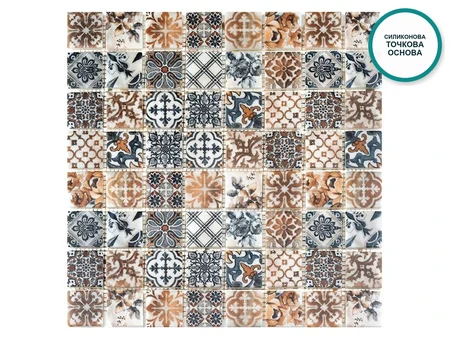
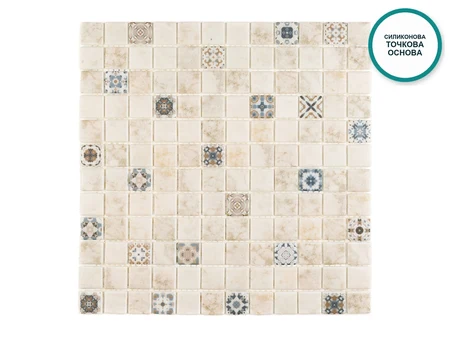
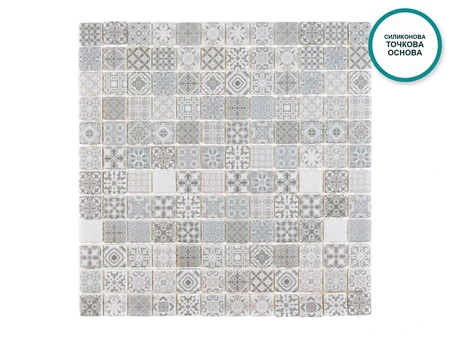
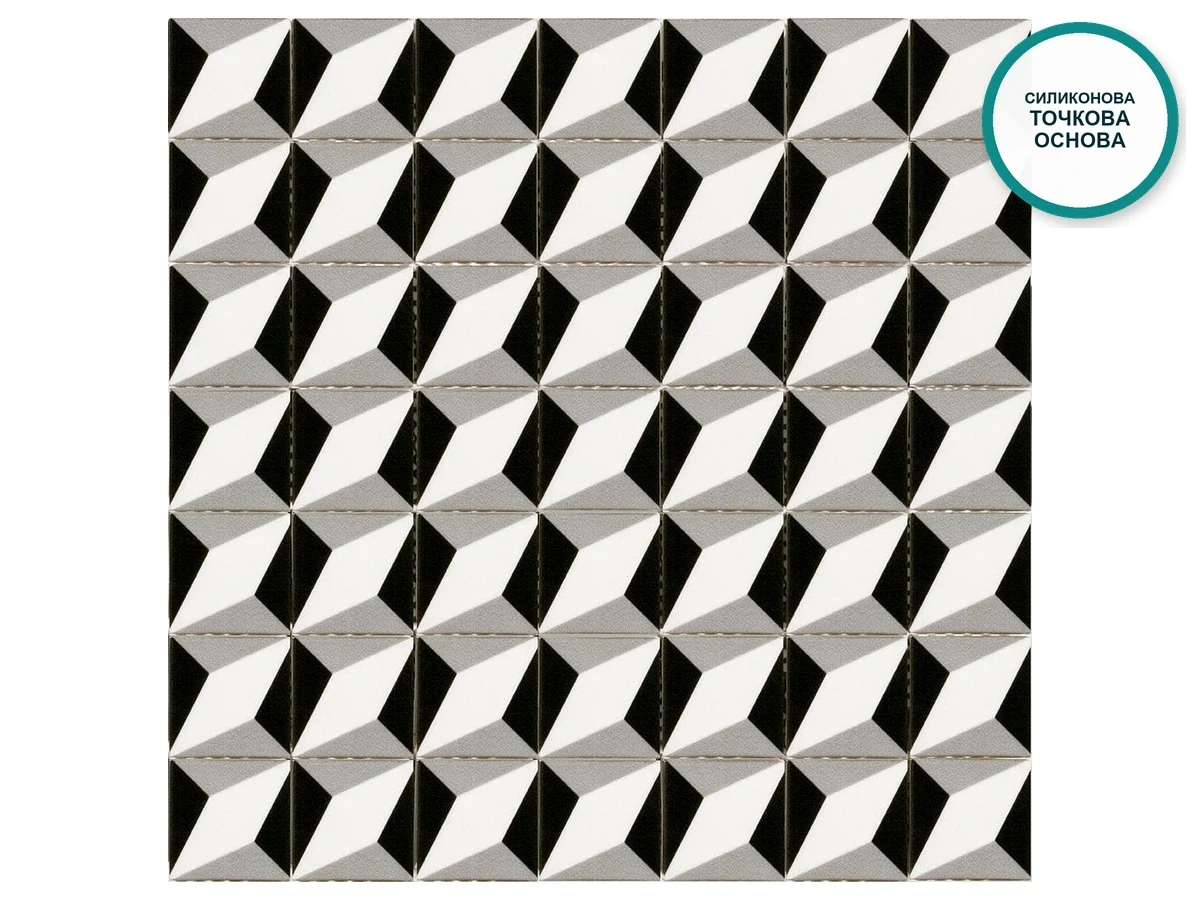
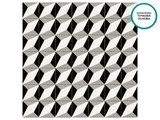
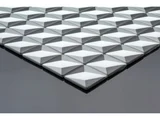
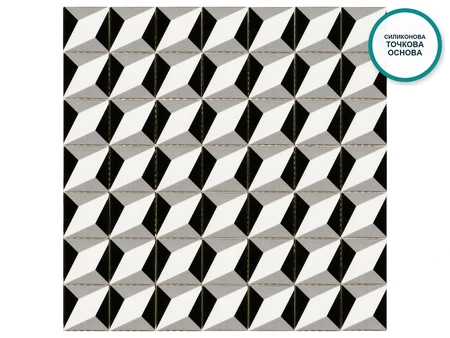
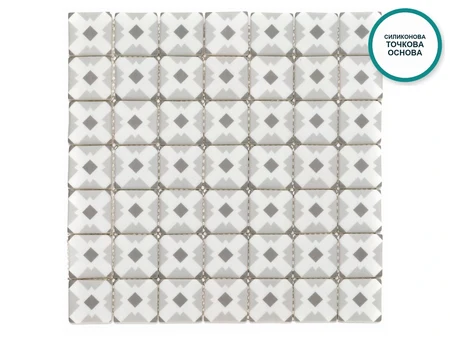
The glass-ceramic mosaic Alcázar is a wall covering for bathrooms and spa areas with square 50 × 50 mm chips. Its design is a black, white and grey geometric pattern. The depth of the surface is enhanced by light and water.
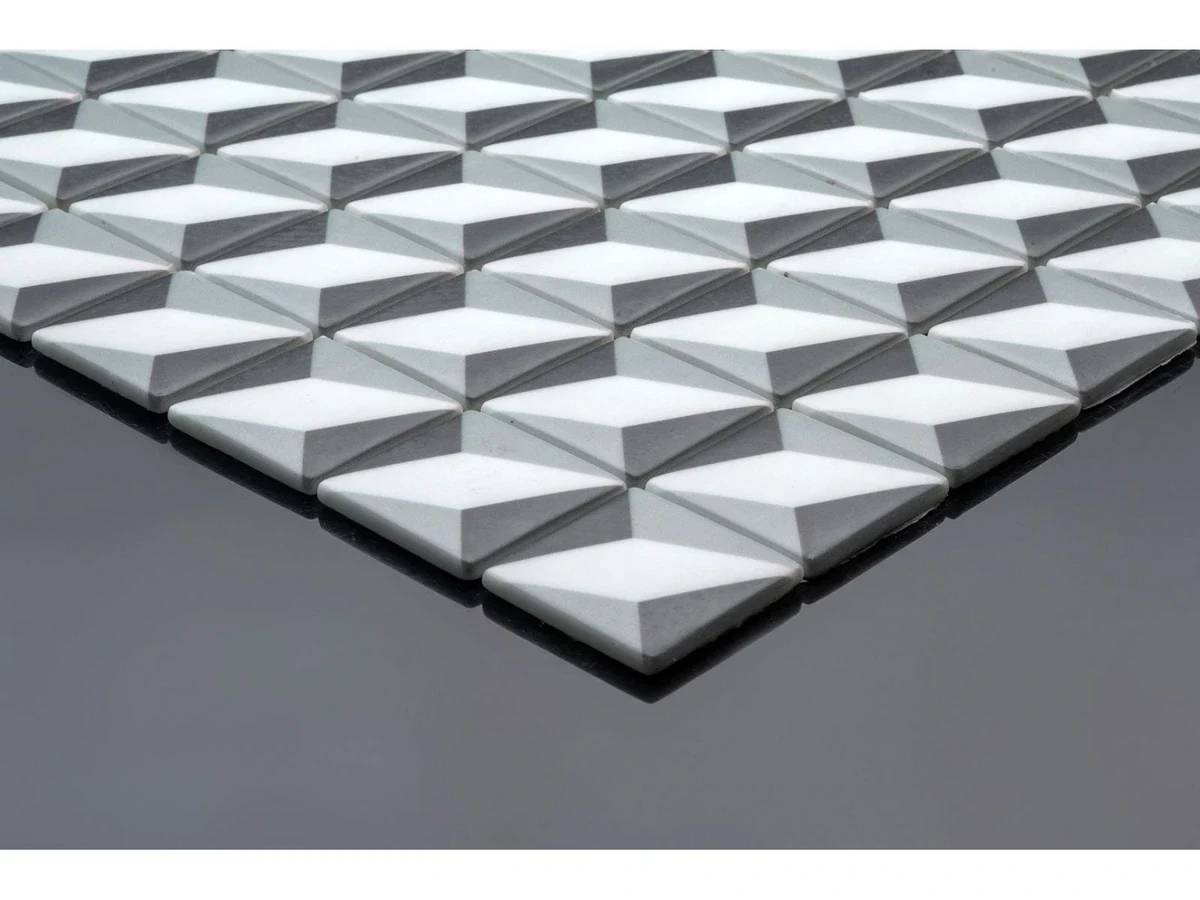
In black, white and grey, the pattern is drawn with bold rhombuses and prisms that trick the eye into seeing raised cubes. The play of dark and light is daring and graphic. It belongs in a single accent wall, an Art Deco bathroom or a contemporary kitchen.
Why it is worth it
- Non-porous glass. It absorbs no more than 0.04 % water, so it does not attract mould, stains or odours.
- Colour that lasts for years. Its tone is not changed by sunlight (ISO 4892) or by cleaning products (class A under ASTM C650).
- Frost-resistant. It withstands freeze-thaw cycles (ASTM C1026), so it can also be used outdoors.
- Strong and smooth. Flexural strength of 55 N/mm² (EN ISO 10545-4) and a surface free of defects.
- Eco-friendly. The raw material is entirely recycled glass, and the colourants contain no lead, cadmium or other heavy metals.
Technical specifications
| Parameter | Value |
|---|---|
| Model | Alcázar |
| Code | MOSFBZDJ001 |
| Shape | square with a printed pattern |
| Chip size | 50 × 50 mm |
| Thickness | 6 mm |
| Material | glass-ceramic made of 100 % recycled glass |
| Shade | black, white and grey geometric pattern |
| Backing | silicone (polyurethane) dots |
| Dimensions of one sheet | 340 × 340 mm |
| Sheets per square metre | 9 |
| Grout joint width | 2 mm |
| Water absorption | no more than 0.04 % (EN ISO 10545-3) |
| Flexural strength | 55 N/mm² (EN ISO 10545-4) |
| Frost resistance | resistant (ASTM C1026) |
| Chemical resistance | class A (ASTM C650) |
| Application | wall coverings in bathrooms, showers, kitchens, spa centres, hammams and decorative panels |
| Packaging | carton containing 1 m² of mosaic |
| Catalogue colour | White, grey, black |
| Type | |
| Effect | Decorative pattern |
Silicone dot backing
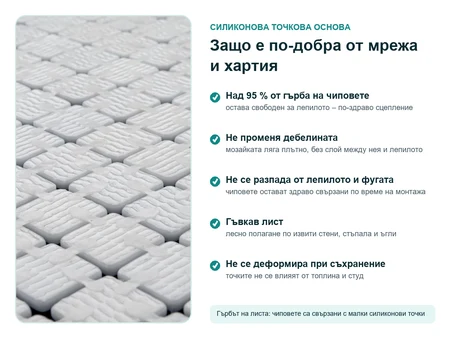
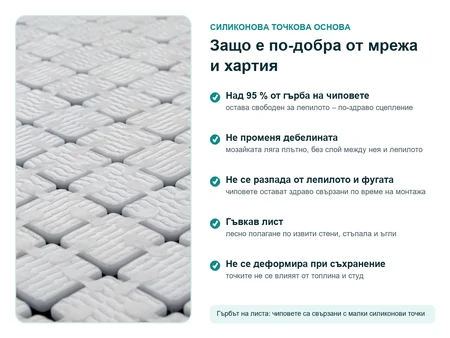
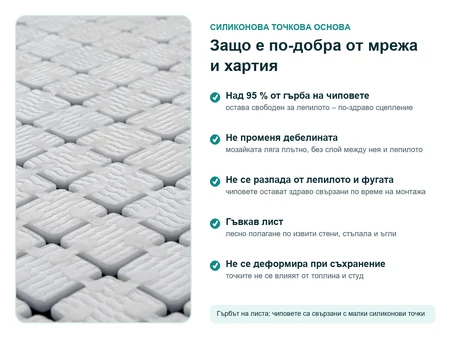
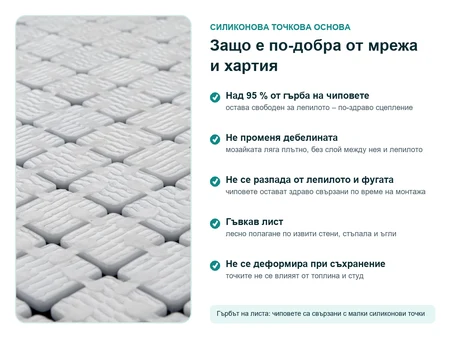
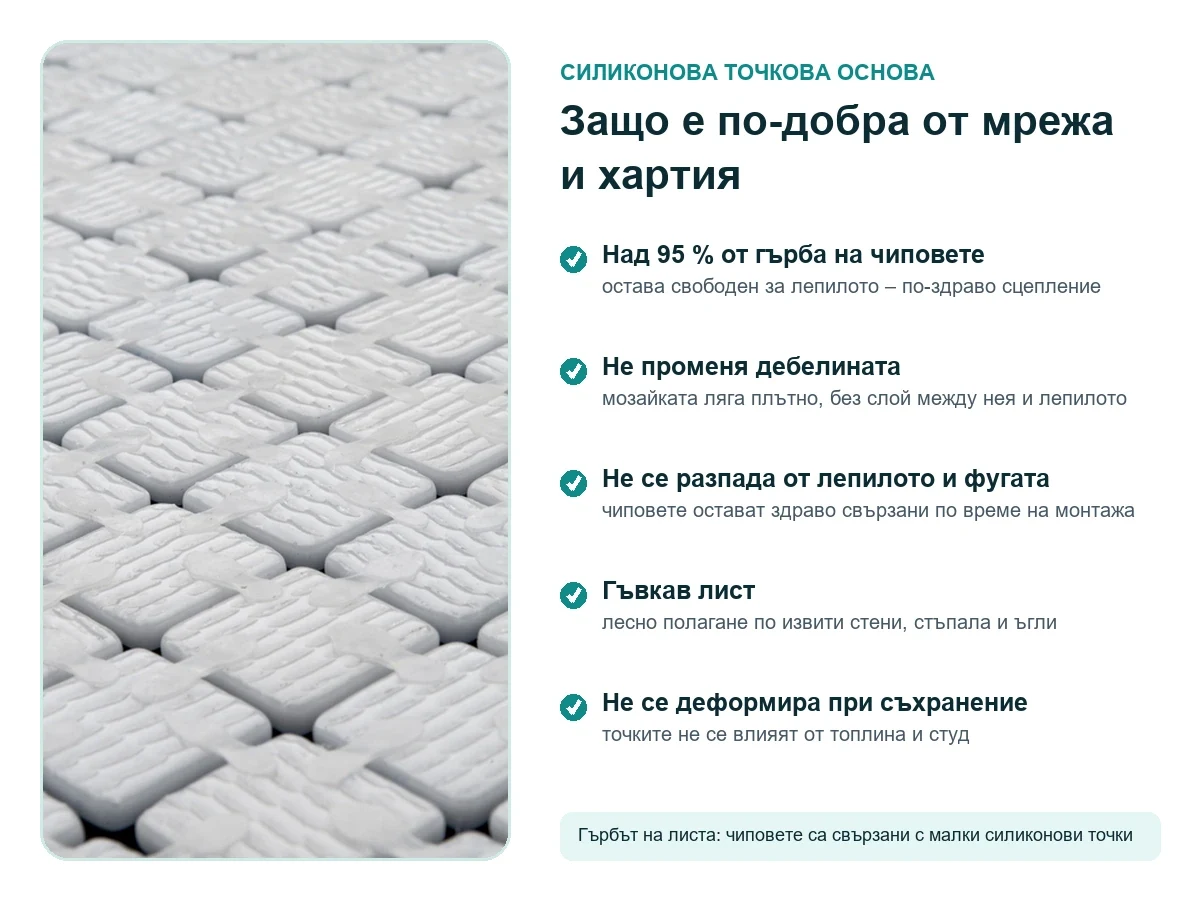
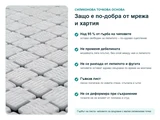
The Alcázar sheets are mounted on a backing of silicone (polyurethane) dots. The small dots hold the chips together without covering their backs, so over 95 % of the surface of each chip remains exposed to the adhesive. Adhesion is very good, the thickness does not change, and the backing is not broken down by adhesive or grout and does not warp in storage. The sheet is flexible and follows curved walls, steps and corners.
| Backing | Silicone dots | Mesh | Paper |
|---|---|---|---|
| Back exposed to the adhesive | over 95 % | part of the back is covered by the mesh | the back is free, but the paper sticks to the front |
| View during installation | chips and joints are visible | chips are visible | chips are under the paper |
| Curves and corners | very easy, the sheet is flexible | good | difficult – the paper tears |
| After installation | nothing to remove | nothing to remove | the paper must be soaked and peeled off |
Where we use it
- Accent walls in bathrooms and spa areas
- Kitchen backsplash with a decorative pattern
- Panels and borders in the interior
Choosing the grout
A black grout strengthens the contrast, while a white one lightens the shapes. When the mosaic is in a shower or another damp environment, use an epoxy or waterproof C2 grout – it does not absorb water and does not darken.
How much material you will need
Work out the area: for each wall, multiply the height by the width and add an allowance for offcuts. For adhesive, allow about 2 kg per m² for chips up to 25 mm, 2.5 kg for 40 mm and 3 kg for larger ones. For the grout, use the expression (A + B) / (A × B) × C × D × 1.6 (the result is in kg per m²) with 50 × 50 mm chips, 6 mm thick, and a 2 mm joint. The figures are only a guideline – actual consumption varies with how even and absorbent the substrate is, the adhesive and grout used, the notch size of the trowel, the width and depth of the joint, the shape of the project and the installer's skill. Also check the technical data sheets of the products and consult your contractor. Buy everything together with an allowance of 5–10 %, so that the mosaic comes from one batch and the shade is uniform.
Installation steps
- Preparing the substrate. The wall must be dry, stable and clean, with unevenness of no more than 2 mm over 2 m. Waterproofing is applied before a shower area.
- Choosing the adhesive. Use a white flexible cement adhesive C2TE S1. The glass is slightly translucent and a grey adhesive would dull the colour.
- Spreading. With a notched trowel (3–4 mm), cover an area big enough for 2–3 sheets.
- Bonding. Press the sheet in and align it with a rubber float. The spacing between sheets must match the 2 mm joint.
- Cutting. Where needed (corners, openings), cut the connections between the dots with a utility knife, and nip off single chips with glass mosaic nippers.
- Grouting. Starts after 24 hours. For a shower cubicle we recommend an epoxy or waterproof C2 grout.
- Cleaning up. A damp sponge removes the grout while it is still soft; epoxy grout is removed immediately with a special cleaner.
- Putting into use. Wet areas should be used only once the grout has fully cured.
Have ready: the white adhesive C2TE S1, grout (epoxy or waterproof), a notched 3–4 mm trowel, a rubber float, a utility knife, glass chip nippers, a sponge and a bucket of clean water.
Standards testing
| Standard | What is tested | Result |
|---|---|---|
| EN ISO 10545-3 | water absorption | no more than 0.04 % |
| EN ISO 10545-4 | flexural strength | 55 N/mm² |
| EN ISO 10545-2 | surface appearance | not a single defect |
| ASTM C650 | chemical resistance | class A, surface unchanged |
| ASTM C1026 | freeze-thaw cycles | passed |
| ISO 4892 | UV exposure | colour unchanged |
| EN ISO 10545 | thermal expansion | passed |
Care and cleaning
- Wipe with a soft cloth or sponge and a neutral cleaner.
- Keep away from abrasive powders, wire brushes and acidic grout cleaners.
- After a shower, go over the surface with a squeegee – no water marks are left on the glass.
Frequently asked questions
What adhesive should be used to install Alcázar?
A white flexible cement adhesive of class C2TE S1 is suitable – it does not dull the colour of the glass.
Which grout is suitable?
In a damp environment, use an epoxy or waterproof one. As for colour, a black grout strengthens the contrast, while a white one lightens the shapes.
Can I buy less than a carton?
No. The mosaic is sold by the carton of 1 m², and it is best for the whole quantity to come from one batch.
Is it suitable for salt water and chlorine?
It is intended for walls and damp rooms; the glass is inert to cleaning products.
Can it go over old tiles?
Yes, if they are sound, clean and degreased and primed with a suitable primer.
Colour in photos and in real life
Glass behaves like a living material – its visible colour depends on the surroundings, so on the wall it may look different from a photo or a visualisation. The most common influences are:
- the screen you are viewing on – brightness, settings and the type of monitor, phone or tablet;
- the lighting – daylight, overcast weather, lamps and their colour;
- the viewing angle, since glass plays with reflections;
- the water in the pool – its depth, clarity, chemical composition and the sky above make it more saturated and bluer;
- the grout, the adhesive and how large the covered surface is;
- neighbouring materials and plants – coping, paving, walls;
- the production batch, between which the shade may differ slightly;
- with mixes and effect glass, each chip is slightly different from its neighbour.
Visualisations of pools and interiors are for guidance only. If the colour is decisive, confirm it before ordering.
Send us the dimensions of the room or pool and we will calculate the square metres and the number of cartons.
See also: Wellness, Pools and Equipment, Cladding and Paving, Pools, Pool Chemicals, Pool Accessories.